
Most new hires in India form their opinion of a company within the first 5 days. If those 5 days feel disorganized, they start updating their LinkedIn profile by the end of the first week. A structured employee onboarding checklist prevents this. It ensures every new hire gets IT access on day one, submits their PAN and Aadhaar before payroll cutoff, understands their role, meets the right people, and starts contributing within 30 days instead of 90. This post covers the complete checklist used by HR teams in Indian companies, from the offer acceptance email to the 90-day performance review.
- 5 phases covered: Pre-boarding, Day 1, Week 1, 30-60-90 day plan, and probation review. Each with a specific checklist.
- India-specific compliance: PAN, Aadhaar, UAN, bank details, tax regime selection, EPF enrollment, and investment declarations explained step-by-step.
- Day 1 schedule: Hour-by-hour template for the new hire’s first day with zero guesswork.
- 30-60-90 day plan: Structured goals and milestones so new hires become productive in 30 days, not 90.
- Manager checklist: Separate tasks for HR, IT, reporting manager, and the new hire so nothing falls through the cracks.
- Common mistakes: The top 7 onboarding errors Indian companies make and how to avoid them.
What Is Employee Onboarding?
Employee onboarding is the structured process of integrating a new hire into your organization from the moment they accept the offer to the end of their probation period. It covers documentation, IT setup, role introduction, team integration, compliance requirements, and performance goal setting. Good onboarding is not a single day of paperwork. It is a 90-day process that determines whether the new hire becomes a productive team member or a quick exit.
For Indian companies, onboarding also includes statutory steps that do not exist in global playbooks. PAN verification, Aadhaar collection, UAN generation for EPF, bank detail validation, tax regime selection, and investment declaration submission. Missing any of these creates payroll errors in the first month, which destroys new hire trust immediately.
The 5 Phases of Employee Onboarding
| Phase | Timeline | Focus |
|---|---|---|
| Phase 1: Pre-boarding | Offer acceptance to Day 0 | Documents, IT setup, welcome kit |
| Phase 2: Day 1 (Orientation) | First day | Welcome, introductions, system access |
| Phase 3: Week 1 (Induction) | Days 2 to 7 | Role training, team integration, policies |
| Phase 4: 30-60-90 Day Plan | Months 1 to 3 | Goals, milestones, performance tracking |
| Phase 5: Probation Review | End of month 3 or 6 | Confirmation, feedback, full absorption |
Phase 1: Pre-Boarding Checklist
Pre-boarding starts the moment the candidate accepts your offer and ends on the day before they join. Most Indian companies waste this window. Done right, it gets 80% of the paperwork out of the way before Day 1.
HR Tasks (Pre-Boarding)
- Send a welcome email within 24 hours of offer acceptance with the joining date, reporting address, and a brief on what to expect on Day 1
- Share the digital joining kit with document upload links (PAN, Aadhaar, 10th and 12th marksheets, degree certificates, previous employer experience letter, last 3 months salary slips, cancelled cheque, passport size photos)
- Collect bank account number, IFSC code, and preferred tax regime (old or new)
- Request previous UAN if the employee has worked before. Generate new UAN only if first job.
- Send signed offer letter, appointment letter, NDA, and company policies for e-signature
- Schedule the Day 1 orientation session and block calendar time for the reporting manager
- Add the new hire to your employee database with temporary status
- Trigger background verification (BGV) if not already initiated. Standard BGV takes 7 to 15 days.
- Order the welcome kit (branded notebook, ID card, company swag) and ensure it reaches by Day 1
IT Tasks (Pre-Boarding)
- Provision laptop with pre-installed software (OS, Microsoft 365 or Google Workspace, Slack or Teams, VPN, required role-specific tools)
- Create email account with proper naming convention ([email protected])
- Set up access to internal systems: HRMS, payroll portal, project management tool, CRM, or any role-specific applications
- Enable SSO (Single Sign-On) access
- Prepare a one-page credentials sheet (username, temporary password, VPN details) for Day 1 handover
- Test laptop login with the new hire’s credentials to confirm everything works
Manager Tasks (Pre-Boarding)
- Send a personal welcome note or short video 2 days before the joining date
- Inform the existing team about the new hire’s role, joining date, and background
- Assign an onboarding buddy (a peer, not a direct report) to help the new hire settle in
- Block calendar for Day 1 (at least 1 hour for one-on-one meeting)
- Prepare the first week’s learning plan and introduce a starter project
- Share the KRA and KPI framework for the role so the new hire knows what success looks like from Day 1
Phase 2: Day 1 Onboarding Checklist (Hour-by-Hour)
Day 1 is the highest-stakes day of the entire onboarding process. A chaotic first day tells the new hire “this company is disorganized.” A structured first day tells them “you are in the right place.” Use this hour-by-hour template.
| Time | Activity | Owner |
|---|---|---|
| 9:00 to 9:30 AM | Reception welcome, ID card handover, office tour, workstation setup | HR / Admin |
| 9:30 to 10:30 AM | HR orientation: company overview, values, organizational chart, employee handbook walkthrough | HR |
| 10:30 to 11:30 AM | Document verification and submission (PAN, Aadhaar, bank details, previous UAN, education certificates) | HR |
| 11:30 to 12:00 PM | IT setup verification: laptop login, email access, VPN, HRMS login, project tools | IT |
| 12:00 to 1:00 PM | Team lunch with reporting manager and onboarding buddy | Manager |
| 1:00 to 2:00 PM | Reporting manager 1:1: role expectations, team structure, first week priorities | Manager |
| 2:00 to 3:30 PM | Team introductions and casual meet-and-greet with key stakeholders | Manager / Buddy |
| 3:30 to 5:00 PM | Start of role-specific training: access to knowledge base, documentation, and starter reading | Buddy |
| 5:00 to 5:30 PM | Day 1 check-in with HR: address any questions, confirm all documents are submitted | HR |
Phase 3: Week 1 Onboarding Checklist
The first week sets the pace for the next three months. Pack it with context, but avoid overload. The new hire should be learning continuously, not drowning in information.
HR and Compliance (Week 1)
- Collect tax declaration (Form 12BB with investment estimates for the year)
- Generate or link UAN on the EPFO portal. First-time employees get a new UAN. Existing PF holders link their old UAN to transfer the balance.
- Register the employee in the ESI portal if gross salary is below Rs 21,000
- Enroll in group health insurance, term life insurance, and any company-provided benefits
- Confirm nominee details for EPF, gratuity, and insurance
- Add the employee to the payroll system with correct salary structure, tax regime, and deductions
- Verify background check status. If delayed, set a 15-day deadline for completion.
Role and Training (Week 1)
- Complete mandatory compliance training: POSH (Prevention of Sexual Harassment), data privacy (DPDP Act), information security, and code of conduct
- Provide access to role-specific documentation, SOPs, and knowledge base
- Schedule product demos, tool training, and system walkthroughs
- Assign a starter task or shadowing opportunity by end of Day 3
- Schedule 1:1 meetings with 5 to 7 cross-functional stakeholders the new hire will work with regularly
Team Integration (Week 1)
- Onboarding buddy checks in daily for the first 5 days
- Manager schedules 15-minute daily check-ins for the first week
- New hire attends regular team meetings, standups, and retrospectives (even as an observer)
- New hire is introduced in the company-wide communication channel (Slack, Teams) with a short bio
- Casual team lunch or coffee chat by end of Week 1
Phase 4: The 30-60-90 Day Plan
The 30-60-90 day plan is the structured roadmap for the first three months. It sets clear expectations for what the new hire should learn, do, and achieve at each stage.
First 30 Days: Learn
The first month is about absorbing context. The new hire is not expected to deliver major outputs yet. They are expected to understand the business, the team, the tools, and the role.
| Goal Area | Milestone |
|---|---|
| Company knowledge | Understand company vision, mission, and key products/services |
| Role clarity | Document role expectations, KRAs, and success metrics |
| Team integration | Complete 1:1 meetings with all direct team members and key stakeholders |
| Tools and systems | Full working knowledge of all required software and processes |
| Quick wins | Complete at least one small project or contribution by Day 30 |
| Feedback | 30-day feedback session with reporting manager |
Days 31 to 60: Contribute
The second month is about applying what has been learned. The new hire takes ownership of tasks, contributes to projects, and starts delivering visible output.
| Goal Area | Milestone |
|---|---|
| Ownership | Own at least 2 to 3 deliverables independently |
| Process contribution | Suggest one process improvement or optimization |
| Stakeholder relationships | Build working relationships with cross-functional partners |
| Skill application | Demonstrate competency in core role responsibilities |
| Feedback | 60-day feedback session with reporting manager and peer input |
Days 61 to 90: Drive
By the third month, the new hire should be operating at expected performance levels. They are no longer a “new employee.” They are a contributing team member with measurable output.
| Goal Area | Milestone |
|---|---|
| Full ownership | Lead at least one project or initiative end-to-end |
| Performance | Meet all role KPIs at expected levels for a confirmed employee |
| Strategic input | Contribute ideas in team strategy and planning discussions |
| Mentorship readiness | Help onboard any new joiner after Day 90 |
| Confirmation review | Formal probation review and confirmation decision |
Phase 5: Probation Review and Confirmation
At the end of 3 or 6 months (depending on company policy), conduct a formal probation review. This is not just a tick-box activity. It determines whether the employee is confirmed, placed on a performance improvement plan, or separated.
- Gather 360-degree feedback: Manager, peers, cross-functional stakeholders, and direct reports (if any)
- Review the 30-60-90 day plan: Did the employee meet the milestones? Any gaps?
- Hold a one-on-one review meeting: Share feedback honestly. Discuss what worked and what did not.
- Issue the confirmation letter: Formally confirm employment in writing. This triggers full benefits (if any were probation-linked) and changes employee status in the HR system.
- Set the next 6-month goals: Transition from onboarding plan to regular performance cycle.
India-Specific Onboarding Compliance
These are the compliance items unique to Indian onboarding that global templates do not cover:
| Document / Step | When | Purpose |
|---|---|---|
| PAN card copy | Pre-boarding | TDS deduction, Form 16 issuance |
| Aadhaar card | Pre-boarding | EPF UAN linking, statutory records |
| UAN number | Week 1 | EPF account continuity from previous employer |
| Bank account + IFSC | Pre-boarding | Salary transfer, reimbursements |
| Tax regime declaration | Week 1 | Old vs new regime selection for TDS calculation |
| Investment declarations (Form 12BB) | Week 1 to Month 3 | Section 80C, 80D, HRA exemption for TDS projection |
| ESI enrollment | Week 1 | Mandatory if gross salary is below Rs 21,000/month |
| Nominee forms | Week 1 | EPF nominee, gratuity nominee, insurance nominee |
| Background verification | Pre-boarding or Week 1 | Education, employment, address, and criminal checks |
| POSH training completion | Week 1 | Mandatory under POSH Act 2013 for companies with 10+ employees |
Onboarding Checklist by Company Size
Onboarding depth varies with company size. A 10-person startup does not need the same process as a 500-person enterprise, but every company needs the essentials.
| Task | 10-50 Employees | 50-200 Employees | 200+ Employees |
|---|---|---|---|
| Digital offer and e-signature | Essential | Essential | Essential |
| Welcome kit and branded swag | Optional | Recommended | Essential |
| Structured Day 1 schedule | Essential | Essential | Essential |
| Assigned onboarding buddy | Recommended | Essential | Essential |
| 30-60-90 day plan | Recommended | Essential | Essential |
| Background verification | Optional | Essential | Essential |
| Formal probation review | Recommended | Essential | Essential |
| Dedicated HRMS onboarding module | Optional | Recommended | Essential |
| Manager training on onboarding | Optional | Recommended | Essential |
Digital vs Physical Onboarding
Since 2020, digital onboarding has become standard for remote and hybrid teams. Both models need the same outcomes but different tools.
- Digital onboarding: Documents collected via secure upload links, e-signed on the HR portal, laptop couriered, Day 1 orientation via video call, team introductions via Slack or Zoom. Requires a robust employee self-service portal.
- Physical onboarding: In-person document verification, on-site orientation, live team lunch, printed welcome kit. Works best for roles with on-site presence requirements (manufacturing, retail, healthcare).
- Hybrid onboarding: Most Indian companies now follow this. Paperwork and some training happen digitally. Day 1 orientation, team meeting, and workstation setup happen in person.
The right approach depends on your role and policy. What matters is consistency. Every new hire should get the same quality of onboarding regardless of the format.
7 Common Onboarding Mistakes
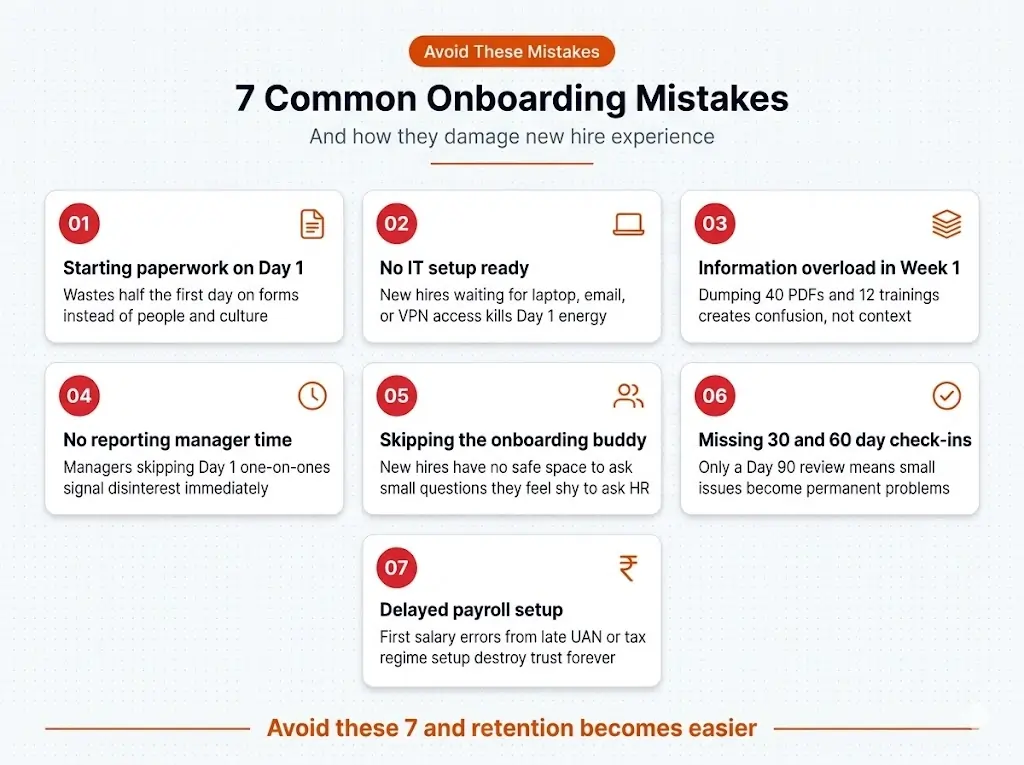
- Starting paperwork on Day 1: Collecting PAN, Aadhaar, and bank details on the first day wastes half the day on forms. Move 80% of the paperwork to pre-boarding through digital links.
- No IT setup ready: A new hire spending Day 1 waiting for email access, VPN, or laptop login is the single biggest energy killer. IT should complete everything 24 hours before the joining date.
- Overwhelming with information: Dumping 40 PDFs, 12 video trainings, and 15 tool tutorials in the first week creates overload. Spread training across Week 1 to Month 2.
- No reporting manager time: Managers who skip Day 1 one-on-ones signal disinterest. Block at least 1 hour on the new hire’s first day even if it is just to set expectations.
- Skipping the onboarding buddy: Buddies answer the questions new hires are too shy to ask the manager. Every new hire should have a peer buddy for the first month.
- Missing the 30-60-90 day review cadence: Most Indian companies have a confirmation review at Day 90 but no structured 30-day or 60-day check-ins. This causes small issues to become permanent problems.
- No payroll setup until month-end: If UAN, bank details, tax regime, and ESI are not set up in Week 1, the first salary has errors. Errors in the first month destroy trust permanently.
How HR Software Improves Onboarding
Manual onboarding breaks at scale. When you have 5 joiners a month, the HR team spends 20 hours per joiner chasing documents, updating systems, and coordinating with IT and managers. Good onboarding software reduces this to 2 hours per joiner.
Key capabilities to look for:
- Digital offer letter with e-signature
- Secure document upload portal for pre-boarding
- Automated task assignment to HR, IT, and managers
- Onboarding progress dashboard showing what is pending
- Integration with payroll (automatic employee master creation)
- 30-60-90 day plan templates with check-in reminders
- Mobile access for new hires to complete formalities
- Integration with DigiLocker and UIDAI for instant document verification
Final Word
A structured employee onboarding checklist is the difference between a new hire who delivers in 30 days and one who quits in 60. The five phases (pre-boarding, Day 1, Week 1, 30-60-90 day plan, and probation review) form a framework that works for any Indian company regardless of size.
For Indian companies specifically, the India-only steps (UAN, tax regime, ESI, nominee forms) need to happen in Week 1. Delays create payroll errors that destroy new hire trust in the first month. If you are scaling your hiring beyond 5 joiners a month, book a free demo to see how automated onboarding handles all of this without HR chasing anyone.
Frequently Asked Questions
What is an employee onboarding checklist?
An employee onboarding checklist is a structured list of tasks HR, IT, and the reporting manager complete to integrate a new hire into the organization. It covers pre-boarding, Day 1, first week, 30-60-90 day milestones, and probation review. For Indian companies, it also includes PAN, Aadhaar, UAN, and tax regime setup.
How long should employee onboarding take?
Effective onboarding takes 90 days. The first month is for learning and absorbing context. The second month is for contributing and taking ownership. The third month is for driving full performance. Some companies extend this to 6 months for complex roles or senior positions.
What should be included in a new hire onboarding checklist?
Include pre-boarding (documents, IT setup, welcome kit), Day 1 (orientation, introductions, system access), Week 1 (training, compliance, tax setup), 30-60-90 day plan (learning, contributing, driving), and probation review. For India, also include UAN, ESI enrollment, tax regime selection, and Form 12BB investment declaration.
What is a 30-60-90 day onboarding plan?
A 30-60-90 day plan sets structured milestones for the first three months. Days 1 to 30 focus on learning the role, team, and tools. Days 31 to 60 focus on contributing to projects and taking ownership. Days 61 to 90 focus on driving full performance and participating in strategic discussions.
Who is responsible for employee onboarding?
Onboarding is a shared responsibility. HR owns documentation, compliance, and orientation. IT owns system and equipment setup. The reporting manager owns role clarity, goals, and team integration. The new hire owns active learning and asking questions. An onboarding buddy provides peer support in the first month.
What is pre-boarding in HR?
Pre-boarding is the period between offer acceptance and Day 1. Most paperwork (PAN, Aadhaar, bank details, BGV), IT setup, and welcome communication should happen during this window. Well-executed pre-boarding means Day 1 focuses on people and culture instead of form-filling.
What documents are needed for onboarding in India?
Required documents include PAN card, Aadhaar card, 10th and 12th marksheets, degree certificates, previous employer experience letter and relieving letter, last 3 months salary slips, cancelled cheque or bank passbook first page, passport size photos, and UAN (if previously employed).
What is a good employee onboarding experience?
A good onboarding experience means IT access ready on Day 1, a clear 30-60-90 day plan, an assigned buddy, regular manager check-ins, zero payroll errors in the first month, and a structured probation review at Day 90. Above all, the new hire feels they made the right choice by joining.
