
It is February. Your payroll is already processed. Then the calls start — ten employees in one morning, all asking the same question: why did my take-home drop by four or five thousand rupees this month?
The answer is almost always the same: TDS recalculation. Investment proofs were not submitted on time. The system defaulted to new tax regime. Or an employee switched regimes without telling HR until it was too late in the year.
For HR managers handling TDS on salary for Delhi employees — and across Gurugram and Noida — this is not just a tax calculation. It is a source of employee complaints, payslip disputes, and compliance risk — all at once. This guide gives you the complete picture: what TDS on salary means for employers, how the new tax regime and old tax regime differ in 2026, and what your HR team must do at each stage of the financial year to get it right.
- New tax regime is the default for FY 2025-26. Every employee who wants the old regime must declare it to HR at the start of the year.
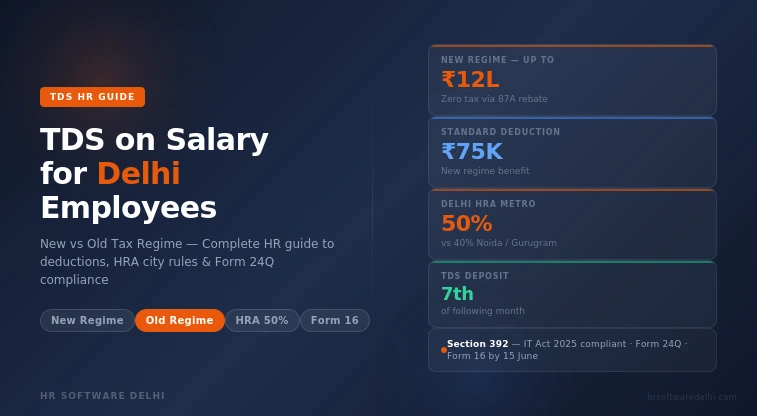
- Under the new regime, income up to ₹12 lakh is effectively tax-free due to the Section 87A rebate of ₹60,000 — with a ₹75,000 standard deduction on top.
- Delhi employees paying rent get a 50% HRA exemption under the old regime. Employees in Noida and Gurugram get only 40%. This single difference can make the old regime significantly more attractive for Delhi staff.
- TDS is calculated under Section 192 of the Income Tax Act (renamed Section 392 under the IT Act 2025, effective April 2026).
- Monthly TDS = projected annual tax liability divided by 12. Recalculated every time an employee submits or revises their investment declaration.
- January to March is the TDS spike season. HR must communicate this to employees proactively, not reactively.
- Form 16 must be issued to all employees by 15 June every year. Late issuance attracts a penalty of ₹200 per day.
What Is TDS on Salary — The Employer’s Legal Obligation
TDS, or Tax Deducted at Source, on salary is the income tax that an employer deducts from an employee’s monthly salary before crediting it to their bank account. The deducted amount is deposited with the Income Tax Department on the employee’s behalf. This mechanism ensures that tax is collected throughout the year rather than as a lump sum payment at year-end.
For employers, TDS on salary is governed by Section 192 of the Income Tax Act, 1961. Under the Income Tax Act 2025 — which comes into force from 1 April 2026 — this section is renumbered as Section 392. The calculation method, rates, and employer obligations remain unchanged. Only the section reference number changes.
What this means practically: if your payroll software or CA currently refers to Section 192 for salary TDS, from April 2026 onwards it should reference Section 392. The compliance steps remain the same.
What employers must do under Section 192:
- Estimate each employee’s total income for the financial year at the start of April
- Deduct TDS monthly based on projected annual income and the employee’s declared tax regime
- Deposit TDS with the government by the 7th of every following month
- File Form 24Q quarterly (July 31, October 31, January 31, May 31)
- Issue Form 16 to every employee by 15 June after the financial year ends
If an employer fails to deduct TDS, the company is treated as the assessee in default and is liable to pay the entire tax amount plus interest at 1.5% per month. This liability sits with the employer, not the employee.
New Tax Regime vs Old Tax Regime — 2026 Updated Slabs
India operates two parallel income tax systems for salaried individuals. Every employee must choose one at the start of each financial year. Their choice directly determines how much TDS is deducted from their salary every month.
New Tax Regime — FY 2025-26 (Default)
| Annual Income Slab | Tax Rate |
|---|---|
| Up to ₹3,00,000 | Nil |
| ₹3,00,001 to ₹7,00,000 | 5% |
| ₹7,00,001 to ₹10,00,000 | 10% |
| ₹10,00,001 to ₹12,00,000 | 15% |
| ₹12,00,001 to ₹15,00,000 | 20% |
| Above ₹15,00,000 | 30% |
Standard deduction under new regime: ₹75,000. Section 87A rebate: ₹60,000 for taxable income up to ₹12 lakh. Net result: employees earning up to ₹12.75 lakh gross pay zero income tax under the new regime.
Old Tax Regime — FY 2025-26
| Annual Income Slab | Tax Rate |
|---|---|
| Up to ₹2,50,000 | Nil |
| ₹2,50,001 to ₹5,00,000 | 5% |
| ₹5,00,001 to ₹10,00,000 | 20% |
| Above ₹10,00,000 | 30% |
Standard deduction under old regime: ₹50,000. All Chapter VI-A deductions available — Section 80C up to ₹1.5 lakh, Section 80D, HRA exemption, LTA, home loan interest under Section 24(b), and more. Section 87A rebate: available only for taxable income up to ₹5 lakh.
The critical difference: The new regime offers lower rates but removes nearly all deductions. The old regime has higher base rates but allows deductions that can dramatically reduce taxable income for employees who invest, pay rent, or service a home loan.
The Delhi NCR HRA Advantage — Why Regime Choice Differs by Office Location
This is the single most overlooked factor in TDS planning for Delhi NCR businesses — and it directly affects whether an employee is better off in the old regime or the new one.
Under the old tax regime, employees paying rent can claim HRA exemption. The exemption amount is calculated as the lowest of three values: actual HRA received, rent paid minus 10% of basic salary, or a percentage of basic salary based on city classification.
That percentage is where location matters:
- Delhi employees — classified as a metro city — qualify for 50% of Basic salary as HRA exemption
- Noida employees — classified as non-metro — qualify for only 40% of Basic salary
- Gurugram employees — also non-metro — qualify for 40% of Basic salary
This single difference of 10 percentage points can change which regime is more beneficial, especially for mid-level employees with CTC between ₹8 lakh and ₹20 lakh.
Example — Same employee, different office locations:
| Detail | Delhi Office (Metro) | Noida Office (Non-Metro) |
|---|---|---|
| Annual CTC | ₹12,00,000 | ₹12,00,000 |
| Basic Salary (40% of CTC) | ₹4,80,000 | ₹4,80,000 |
| HRA received | ₹2,40,000 | ₹2,40,000 |
| Annual rent paid | ₹1,80,000 | ₹1,80,000 |
| HRA exemption cap (city %) | ₹2,40,000 (50%) | ₹1,92,000 (40%) |
| Rent minus 10% basic | ₹1,32,000 | ₹1,32,000 |
| Actual HRA exemption | ₹1,32,000 | ₹1,32,000 |
In this example the HRA exemption turns out the same — because rent paid minus 10% basic is the limiting factor for both. But for employees paying higher rent relative to their basic, the 50% metro cap matters significantly. An employee paying ₹25,000/month in Delhi rent with ₹40,000 basic monthly would claim ₹2,40,000 exemption under Delhi’s metro classification vs ₹1,92,000 in Noida — a difference of ₹48,000 in taxable income, translating to ₹9,600–₹14,400 less tax in the old regime.
The practical implication for HR teams: when an employee transfers from a Noida office to a Delhi office, their optimal tax regime may change. This should be flagged at the time of transfer, not discovered in March.
HR Software Delhi automatically applies the correct HRA city classification, tax regime, and TDS calculation for each employee based on their work location — no manual switching between offices.
Step-by-Step TDS Calculation — The HR Manager’s Workflow
TDS on salary is not a flat percentage. It is a projection exercise done at the start of the year, recalculated every time an employee updates their declarations, and finalised in the last three months when all proofs come in.
Here is the step-by-step process for a Delhi NCR employer:
Step 1: Estimate annual gross salary
Include all components — basic, HRA, special allowance, LTA, medical reimbursement, performance bonus (estimated), and any perquisites. For employees with variable pay, use a reasonable estimate.
Step 2: Subtract exemptions (old regime only)
If the employee has opted for the old regime, subtract: actual HRA exemption claimed (based on rent receipts and city classification), LTA exemption (once in two years), and any other allowance exemptions applicable.
Step 3: Subtract standard deduction
New regime: ₹75,000. Old regime: ₹50,000. This applies to all salaried employees regardless of declarations.
Step 4: Subtract Chapter VI-A deductions (old regime only)
Based on investment declarations submitted by the employee: Section 80C (up to ₹1,50,000), Section 80D (health insurance premiums), Section 24(b) (home loan interest up to ₹2,00,000 for self-occupied), Section 80CCD(1B) (NPS additional up to ₹50,000), and others.
Step 5: Calculate annual tax liability
Apply the applicable slab rates to the net taxable income. Add 4% health and education cess. Apply Section 87A rebate if applicable.
Step 6: Divide by 12
The result is monthly TDS. Deduct this from the employee’s salary every month.
Worked example — Delhi employee, ₹10 lakh CTC:
| Calculation Step | New Tax Regime | Old Tax Regime |
|---|---|---|
| Gross annual salary | ₹10,00,000 | ₹10,00,000 |
| HRA exemption | Not applicable | ₹1,00,000 |
| Standard deduction | ₹75,000 | ₹50,000 |
| 80C deduction | Not applicable | ₹1,50,000 |
| 80D deduction | Not applicable | ₹25,000 |
| Net taxable income | ₹9,25,000 | ₹6,75,000 |
| Tax before cess | ₹52,500 | ₹42,500 |
| Add 4% cess | ₹2,100 | ₹1,700 |
| Annual tax liability | ₹54,600 | ₹44,200 |
| Monthly TDS | ₹4,550 | ₹3,683 |
In this example the old regime saves this employee ₹10,400 annually — ₹867 per month in take-home — because of sufficient deductions (HRA + 80C + 80D = ₹2.75 lakh). For employees without these deductions, the new regime’s lower rates would win.
Which Regime Saves More — The Breakeven Calculator for HR Teams
The question every employee asks in April is: which regime should I choose? The answer depends entirely on how much they can legitimately claim in deductions. Here is the breakeven table that HR teams can use to guide employees:
| Annual CTC | Deductions needed to make Old Regime better | Typical employee profile |
|---|---|---|
| ₹5,00,000 | Any amount — new regime gives zero tax via 87A | New regime is better for almost everyone |
| ₹7,50,000 | ₹1,00,000+ | Old regime better if paying rent + basic 80C |
| ₹10,00,000 | ₹2,00,000+ | Old regime better with HRA + 80C + 80D |
| ₹12,00,000 | ₹2,50,000+ | Old regime better with home loan + 80C |
| ₹15,00,000 | ₹3,25,000+ | Old regime better with home loan + full 80C + 80D |
| ₹20,00,000+ | ₹3,75,000+ | Depends heavily on home loan interest claimed |
The simplest rule of thumb: if an employee is paying significant rent in Delhi (where metro HRA gives 50% exemption) AND has ₹1.5 lakh in 80C investments AND pays health insurance premiums, the old regime almost always wins for salaries between ₹8 lakh and ₹18 lakh. Above ₹18 lakh, the new regime’s flat 30% rate and absence of complexity starts to compete even with large deductions.
HR Manager’s TDS Calendar — What to Do Each Month
TDS on salary is not a once-a-year task. It runs on a monthly compliance cycle with four critical pressure points during the year.
| Month | HR Action Required | Deadline |
|---|---|---|
| April | Collect tax regime declarations from all employees. New joiners default to new regime unless they opt out in writing. | First week of April |
| April | Collect initial investment declarations (Form 12BB) for old regime employees. | Before first payroll of year |
| Every month | Deduct TDS based on current projections. Deposit with government. | 7th of following month |
| July 31 | File Form 24Q (Q1 — April to June). | 31 July |
| October 31 | File Form 24Q (Q2 — July to September). | 31 October |
| December–January | Send reminder to all employees to submit investment proofs. Deadline is typically employer-defined — most set it as 31 January. | Employer-defined, usually 31 Jan |
| January 31 | File Form 24Q (Q3 — October to December). | 31 January |
| February–March | Recalculate TDS for employees who did not submit proofs — deduct shortfall across remaining months. Communicate upcoming TDS spike to employees in advance. | Before February payroll |
| May 31 | File Form 24Q (Q4 — January to March). | 31 May |
| 15 June | Issue Form 16 to all employees. | 15 June — statutory deadline |
The February-March period deserves extra attention. Any employee who declared investments at the start of the year but did not submit proofs by January will have their TDS recalculated assuming zero deductions. This means their remaining two or three months of TDS must absorb the entire year’s shortfall — causing a sharp temporary drop in take-home that HR teams must explain proactively, not reactively.
IT Act 2025 — What Changes for TDS on Salary from April 2026
The Income Tax Act 2025 received presidential assent and comes into force from 1 April 2026. For TDS on salary, the changes are primarily structural rather than substantive.
The most significant change for payroll teams: all TDS provisions previously spread across more than 60 sections (Section 192 to 194T) are now consolidated into three sections under the new Act:
- Section 392 — TDS on salary income (previously Section 192)
- Section 393 — TDS on non-salary payments (previously Sections 194 to 194T)
- Section 394 — TCS provisions
What does not change: tax rates, slab structures, standard deductions, exemption rules, investment declaration procedures, Form 24Q filing, Form 16 issuance, or any calculation methodology. The Section 87A rebate continues. The new regime default continues. The 50%/40% HRA city classification continues.
The practical action for HR teams: update any internal documentation, payslip templates, or payroll system references from Section 192 to Section 392. If your payroll software vendor has not already issued an update for this, raise it with them before April 2026.
HR Software Delhi’s payroll engine is updated for the Income Tax Act 2025. Section references, Form 24Q filings, and Form 16 generation all reflect the new Act from April 2026 — with zero action required from your team.
7 TDS Mistakes Delhi HR Teams Make Every Year
1. Not collecting regime declarations in April
When HR skips this step, the payroll system defaults all employees to the new tax regime. Employees who would have benefited from the old regime — particularly those paying high rent in Delhi — end up overpaying TDS all year. Recovering this via ITR refund takes months and damages employee trust in HR.
2. Applying wrong HRA city classification for multi-location staff
An employee based out of Gurugram is non-metro. The same employee transferred to the Delhi office becomes metro. If payroll is not updated at the time of transfer, HRA exemption is calculated at 40% when 50% applies — or vice versa. Either way, the TDS is wrong.
3. Missing the investment proof deadline
The standard employer deadline for investment proof submission is 31 January. Many HR teams send reminders in February — too late. The result is a TDS spike in February and March that catches employees off guard. Set the internal deadline at 20 January and send the first reminder in December.
4. Not accounting for previous employer’s income
When an employee joins mid-year, they must submit their previous employer’s Form 12B showing income and TDS already deducted. If HR does not collect this, they calculate TDS assuming the current salary is the employee’s only income for the year. The result is under-deduction, and a shortfall that surfaces at year-end.
5. Treating all perquisites as non-taxable
Company car personal use, club membership fees, rent-free accommodation, and interest-free loans are taxable perquisites. Their value must be estimated and added to the employee’s taxable income for TDS calculation. Many Delhi companies miss this for senior employees, creating a TDS shortfall that is difficult to recover.
6. Missing the Section 87A rebate for eligible employees
Employees with taxable income up to ₹12 lakh under the new regime are eligible for a ₹60,000 rebate under Section 87A — effectively making their tax liability zero. Some payroll systems, if not configured correctly, calculate TDS before applying this rebate. The employee ends up with TDS deducted when none should be. Always verify rebate application for employees in the ₹10–₹13 lakh gross salary range.
7. Late or missing Form 16
Form 16 is not optional and not flexible. The statutory deadline is 15 June. Late issuance attracts a penalty of ₹200 per day under Section 272A. For a company with 100 employees where Form 16 is issued 30 days late, the penalty exposure is ₹6,00,000. More importantly, employees cannot file their ITR accurately without Form 16, which creates cascading problems in June and July.
Frequently Asked Questions
Is new tax regime mandatory from FY 2025-26?
The new tax regime is the default regime, meaning employers will apply it automatically if an employee does not make a declaration. It is not mandatory — employees can opt for the old tax regime by informing their employer at the start of the financial year. If an employee does not inform HR, new regime TDS will be deducted throughout the year. They can still switch at the time of ITR filing, but any refund will take several months to process.
Can an employee change their tax regime mid-year?
Employees can change their regime declaration with their employer only once during the financial year. After that change, no further switch is allowed until the next financial year. However, at the time of filing the Income Tax Return (typically by 31 July), salaried employees can choose whichever regime results in lower tax, regardless of what they declared to their employer. If the ITR regime differs from the employer’s TDS deduction regime, the difference will either be refunded or demanded by the Income Tax Department.
What is the TDS rate on salary?
There is no single TDS rate on salary. TDS on salary is deducted according to the applicable income tax slab rates for the chosen regime. It is not a flat percentage like TDS on other incomes. The employer estimates the employee’s total annual income, calculates the annual tax, and divides by 12 to arrive at monthly TDS.
What happens if an employer deducts excess TDS?
The excess TDS is reflected in the employee’s Form 26AS and AIS. The employee can claim a refund by filing their ITR before the deadline. The employer cannot directly refund excess TDS once it has been deposited with the government. This is why accurate TDS calculation throughout the year matters — it avoids cash flow disruption for employees.
Is HRA available under the new tax regime?
No. HRA exemption is not available under the new tax regime. Employees opting for the new regime cannot claim any exemption on HRA received, regardless of rent paid. This is one of the primary reasons that Delhi employees paying significant rent often find the old regime more beneficial.
What is Form 12BB and when does an employee submit it?
Form 12BB is the investment declaration form that an employee submits to their employer for TDS calculation under the old regime. It includes details of HRA, LTA, home loan interest, and all Chapter VI-A deductions. It is submitted at the beginning of the financial year with estimated amounts, and again at the end of the year with actual proof of investment.
When must TDS be deposited with the government?
TDS deducted from employee salaries must be deposited by the 7th of the following month. For March salary, the TDS can be deposited by 30 April. Late deposit attracts interest at 1.5% per month from the date of deduction to the date of deposit.
What is Form 26AS and why should HR care?
Form 26AS is the consolidated TDS credit statement available on the Income Tax Department portal. It shows all TDS deducted and deposited against an employee’s PAN. If the employer deposits TDS but does not correctly link it to the employee’s PAN in the challan, the credit will not appear in the employee’s Form 26AS — and the employee will face a tax demand despite the employer having deposited the amount. HR teams should verify Form 26AS entries after every quarterly filing.
Conclusion
TDS on salary is one of those compliance areas that feels manageable until it is not. A missed declaration in April. A wrong city code for HRA. An investment proof reminder that went out one week too late. Each of these creates a chain of consequences that lands in HR’s inbox — employee complaints, payslip disputes, Form 16 delays, and in some cases, tax department notices.
The companies that handle TDS well do not have smarter HR teams. They have better systems. When attendance data flows automatically into payroll, when each employee’s work location determines their HRA city classification without manual input, when the payroll engine applies the correct rebates and files Form 24Q on schedule — TDS becomes something that runs in the background rather than something that requires firefighting every February.
That is what payroll automation looks like for Delhi NCR businesses running multi-location teams across Delhi, Gurugram, and Noida.
HR Software Delhi handles regime declarations, HRA city classification, investment proof reminders, TDS calculation, Form 24Q filing, and Form 16 generation — built specifically for Delhi NCR businesses operating across multiple offices.
