
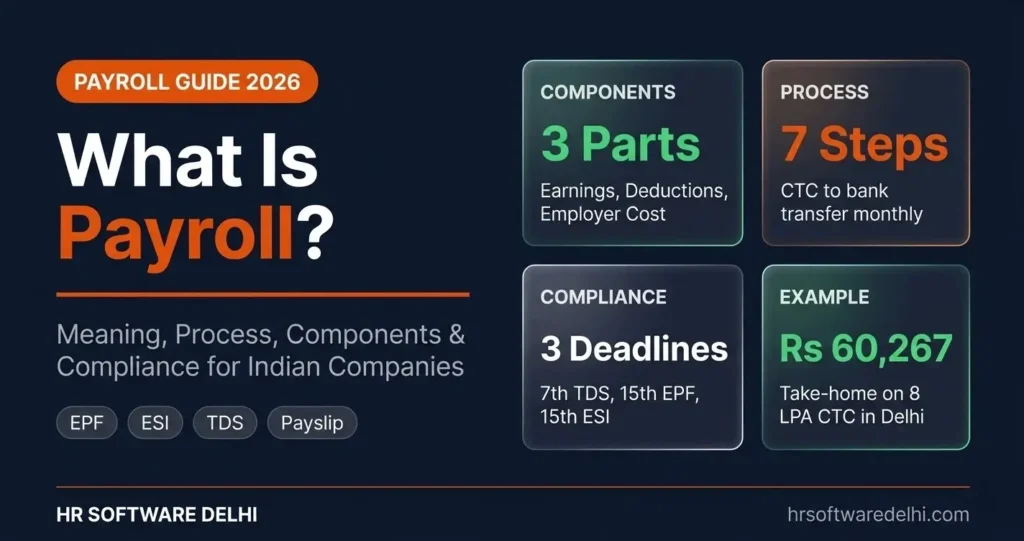
Payroll is the process of calculating employee salaries, deducting taxes, and paying employees on time every month. That is the simple definition. But in India, payroll also means calculating EPF at 12%, deducting ESI for eligible staff, withholding TDS based on tax slabs, and filing returns with three different government departments before strict monthly deadlines. Get any of these wrong and your company faces penalty notices, interest charges, and employee complaints. This guide breaks down exactly how payroll works for Indian companies, with real numbers and actual compliance deadlines.
- Payroll meaning: The complete process of calculating, deducting, paying, and reporting employee salaries every month.
- Payroll components: Earnings (Basic, HRA, allowances), deductions (EPF, ESI, TDS, PT), and employer contributions.
- Payroll process in India: 7 steps from attendance collection to compliance filing, with strict monthly deadlines.
- Payroll compliance: EPF by 15th, TDS by 7th, ESI by 15th. Late filing attracts 5% to 25% damages.
- Payroll calculation: An Rs 8 LPA CTC employee in Delhi takes home Rs 60,267 per month after EPF deduction (zero TDS under new regime).
What Is Payroll?
From an employer perspective, payroll is the structured process of calculating and distributing employee compensation. It includes determining salaries based on employment contracts, tracking attendance, applying statutory deductions, and ensuring employees are paid accurately and on time. For companies in Delhi NCR, payroll is not optional administration. It is a critical financial and legal function governed by the Payment of Wages Act.
In practical terms, payroll meaning extends beyond just transferring salaries. It covers salary calculation, tax withholdings (TDS deduction under Section 192), statutory compliance, payslip generation, and bank transfers. In India, payroll also means ensuring that EPF contribution, ESI contribution, professional tax, and LWF are calculated and filed with government portals every month. A single error in the payroll process in India can trigger penalties, audits, and employee disputes.
Payroll Components in India
Every salary in India is built from three parts: what the employee receives (earnings), what gets deducted (deductions), and what the company pays to the government on the employee’s behalf (employer contributions).
Earnings
These add up to form the gross salary:
- Basic Salary: Core compensation, typically 40% to 50% of CTC. Forms the base for EPF, gratuity, and HRA calculations.
- HRA (House Rent Allowance): Covers rental expenses. Structured at 50% of basic salary in metro cities like Delhi, 40% in non-metro locations like Noida and Gurugram.
- Dearness Allowance: Cost of living adjustment, common in manufacturing and government sectors.
- Special Allowance: Fully taxable balancing figure that makes up the remainder of CTC after basic and HRA.
- LTA (Leave Travel Allowance): Reimburses domestic travel expenses with specific tax benefits when claimed with valid proof.
- Performance Bonus: Variable pay linked to employee output or company revenue targets.
Deductions
Deductions reduce gross salary to arrive at net salary (take-home pay):
- EPF (Employee Provident Fund): 12% of Basic + DA deducted from employee salary.
- ESI (Employee State Insurance): 0.75% of gross salary, applicable only for employees earning up to Rs 21,000 per month.
- TDS (Tax Deducted at Source): Income tax withheld based on the applicable slab and employee declarations.
- Professional Tax: State-level employment tax, capped at Rs 2,500 per year.
- LWF (Labour Welfare Fund): Small statutory deduction that varies by state.
Employer Contributions
These are costs borne by the company over and above the gross salary:
- EPF Employer Share: 12% of Basic + DA (split into PF and EPS accounts).
- ESI Employer Share: 3.25% of gross salary for ESI-eligible employees.
- Gratuity Provision: 4.81% of Basic salary, payable after five years of continuous service.
| Component | Monthly (Rs) | Annual (Rs) | Type |
|---|---|---|---|
| Basic Salary | 25,000 | 3,00,000 | Earning |
| HRA | 12,500 | 1,50,000 | Earning |
| Special Allowance | 12,500 | 1,50,000 | Earning |
| EPF Employee | 3,000 | 36,000 | Deduction |
| EPF Employer | 3,000 | 36,000 | Employer Cost |
How Payroll Works: 7 Step Process
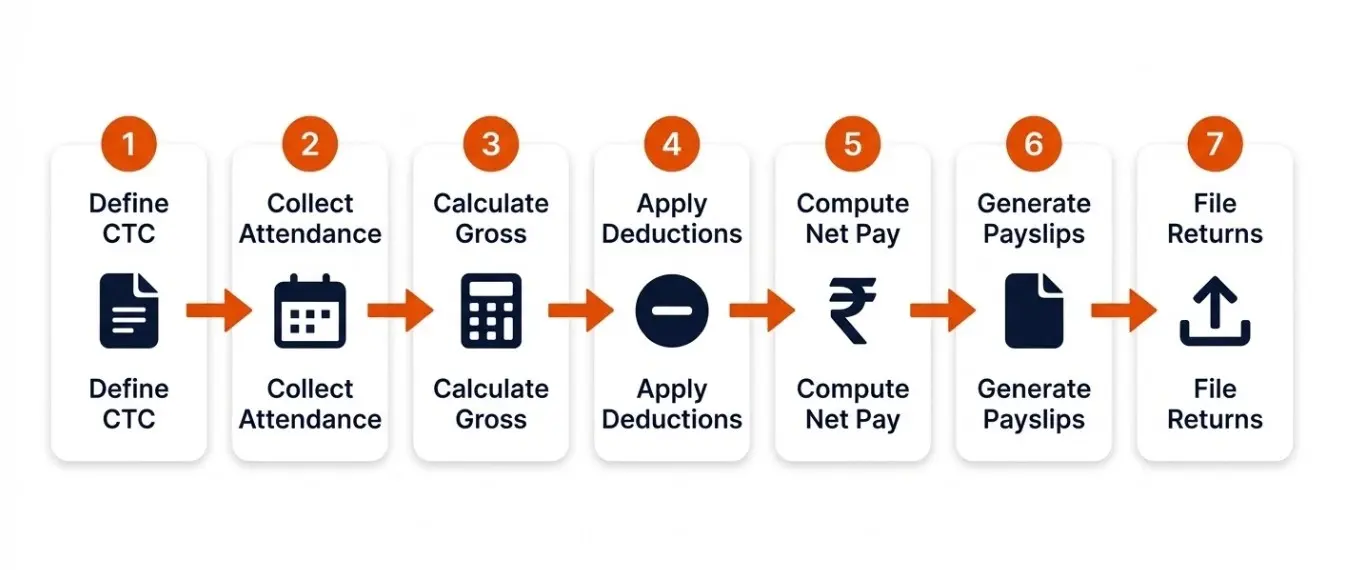
Payroll runs on the same cycle every month. Here is the exact sequence that every Indian company follows:
- Define salary structure and CTC breakup: Split the total Cost to Company into basic salary, HRA, allowances, and statutory contributions. This directly affects every subsequent payroll calculation.
- Collect monthly attendance and leave data: Accurate records of days worked, leaves taken, and overtime must be gathered from your attendance management system of days worked, Loss of Pay days, overtime, and approved leaves. Loss of Pay days are deducted from basic salary, making accurate leave tracking critical for correct payroll.
- Calculate gross salary: Add basic salary and all allowances for the month. This is the total before any deductions.
- Apply statutory deductions: Calculate EPF, ESI, TDS, and professional tax as per applicable law. Accuracy here is non-negotiable for payroll compliance.
- Compute net pay: Subtract all deductions from gross salary. This is the actual take-home pay credited to the employee.
- Generate payslips and process bank transfers: Disburse salary to employee bank accounts and distribute payslips for transparency.
- File compliance returns: Deposit TDS by 7th, file EPF ECR challan by 15th, and ESI payment by 15th of the following month. See our step-by-step payroll processing guide for the full walkthrough.
Payroll Calculation: Worked Example (Rs 8 LPA)
Numbers make payroll real. Here is the exact monthly calculation for an employee in Delhi earning Rs 8,00,000 CTC per year. Every line item is shown so you can replicate this for your own team.
Key assumptions:
- Gross salary exceeds Rs 21,000/month, so ESI does not apply
- Delhi levies zero professional tax
- Under the new tax regime, taxable income (Rs 6,86,600 after Rs 75,000 standard deduction) is below Rs 7,00,000, so Section 87A rebate applies and TDS is zero
| Component | Monthly (Rs) | Annual (Rs) |
|---|---|---|
| Annual CTC | 66,667 | 8,00,000 |
| Basic Salary (40% of CTC) | 26,667 | 3,20,000 |
| HRA (50% of Basic) | 13,333 | 1,60,000 |
| Special Allowance | 23,467 | 2,81,600 |
| EPF Employer (12% of Basic) | 3,200 | 38,400 |
| Monthly Gross Salary | 63,467 | 7,61,600 |
| EPF Employee Deduction (12%) | 3,200 | 38,400 |
| ESI Employee | 0 | 0 |
| Professional Tax | 0 | 0 |
| TDS (New Regime, 87A rebate) | 0 | 0 |
| Monthly Net Take-Home | 60,267 | 7,23,200 |
Math check: CTC = Gross (7,61,600) + EPF Employer (38,400) = 8,00,000. Net = Gross (63,467) minus EPF Employee (3,200) = 60,267/month. Use our CTC to in-hand salary calculator to run your own numbers.
Payroll Compliance in India
EPF (Employee Provident Fund)
Applicable to companies with 20 or more employees. Both employee and employer contribute 12% of Basic + DA. Employers can cap their contribution at the statutory wage ceiling of Rs 15,000 (Rs 1,800/month maximum). The ECR challan must be filed and deposited by the 15th of the following month.
ESI (Employee State Insurance)
Mandatory for companies with 10 or more employees. Applies only to employees earning up to Rs 21,000 gross per month. The employee contributes 0.75% and the employer contributes 3.25%. Payment and filing are due by the 15th of the following month on the ESIC portal.
TDS on Salary
Governed by Section 192 of the Income Tax Act (transitioning to Section 392 from April 2026 under the new Income Tax Act 2025). The employer estimates annual tax liability, divides by 12, and deducts monthly. TDS must be deposited by the 7th of the following month. Quarterly returns are filed via Form 24Q, and Form 16 must be issued to all employees by 15 June. For a detailed breakdown, see our TDS on salary guide for Delhi employees.
Professional Tax
A state-level tax on employment. Rates vary significantly across Delhi NCR:
| State | Salary Threshold | PT Amount |
|---|---|---|
| Delhi | All salary ranges | Rs 0 (not levied) |
| Haryana | Above Rs 15,000/month | Rs 200/month |
| Uttar Pradesh | Varies by designation | Up to Rs 2,500/year |
For complete state-wise rates, see our professional tax Delhi NCR guide.
LWF (Labour Welfare Fund)
A minor but legally mandatory deduction. Delhi requires Rs 1 from the employee and Rs 2 from the employer every six months. Haryana and UP have different rates. Despite the small amount, non-compliance attracts disproportionate administrative penalties.
Monthly Payroll Compliance Calendar
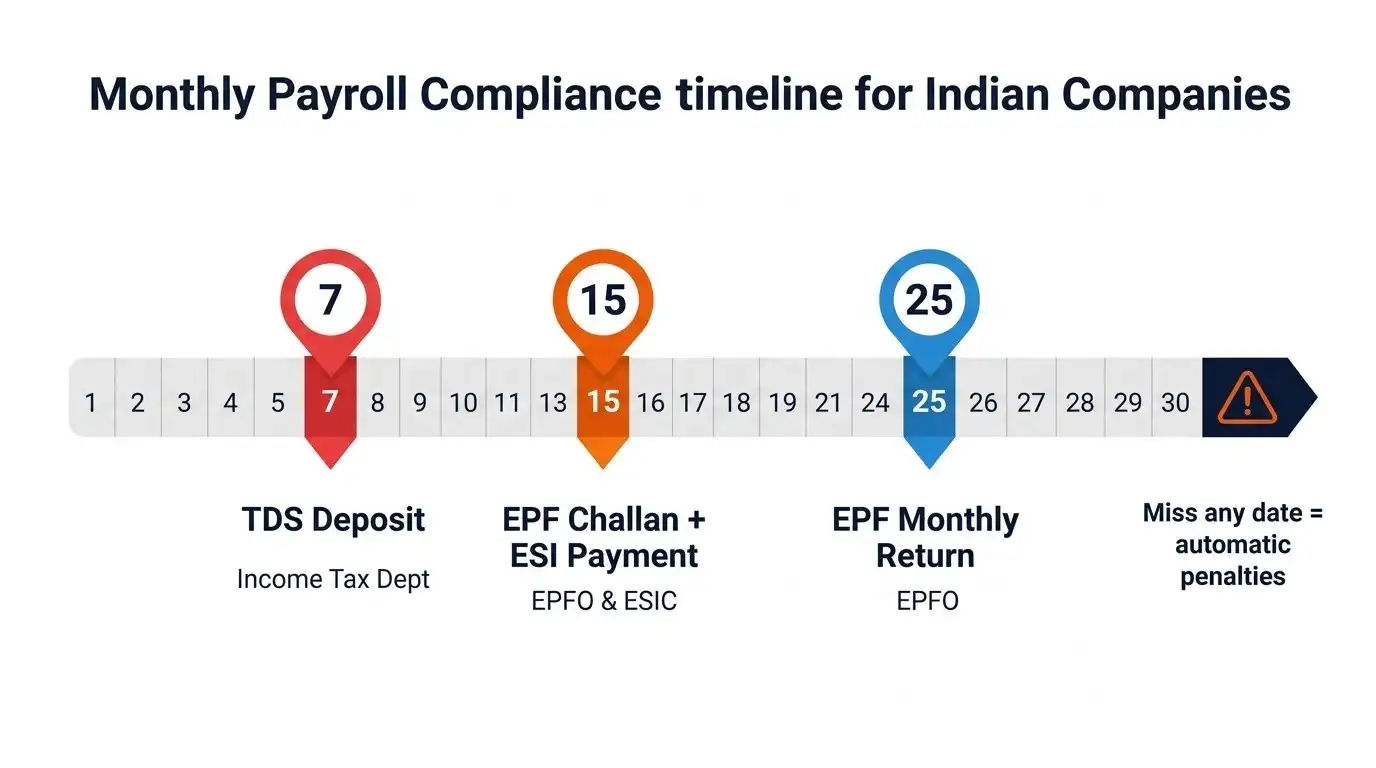
Every HR manager should have these dates memorized. Missing even one triggers automatic penalties:
| Deadline | Filing/Payment | Authority | Penalty for Delay |
|---|---|---|---|
| 7th of month | TDS deposit | Income Tax Department | 1.5% interest per month |
| 15th of month | EPF challan + ESI payment | EPFO and ESIC | 5% to 25% damages (EPF), 12% interest (ESI) |
| 21st of month | ESI half-yearly return | ESIC | Monetary fine |
| 25th of month | EPF monthly return | EPFO | Late filing fees |
| Quarterly | Form 24Q (TDS return) | Income Tax Department | Rs 200 per day under Section 234E |
| 15 June (Annual) | Form 16 to employees | Income Tax Department | Rs 100 per day per employee |
Payroll Penalties for Late Filing
These are the actual penalty amounts Indian companies face for payroll compliance delays:
| Compliance | Delay Period | Penalty |
|---|---|---|
| EPF | Up to 2 months | 5% damages on contribution amount |
| EPF | 2 to 4 months | 10% damages |
| EPF | 4 to 6 months | 15% damages |
| EPF | Above 6 months | 25% damages + possible prosecution |
| ESI | Any delay | 12% annual interest on delayed amount |
| TDS | Late deposit | 1.5% per month interest + Rs 200/day (Section 234E) |
Payroll Processing Methods
Manual (Excel)
Suitable only for teams under 10 employees. Free and familiar, but highly error-prone with zero compliance automation and no payslip generation.
Payroll Software
Best for companies with 10 to 500 employees. A dedicated payroll software platform automates the entire calculation, generates compliant payslips, creates bank files, and files statutory returns. Typical cost: INR 50 to 150 per employee per month.
Outsourcing
Best for companies without dedicated HR or payroll staff. Transfers compliance responsibility externally. Drawbacks include less control, higher per-employee cost, and sharing sensitive salary data with a third party.
| Factor | Manual (Excel) | Payroll Software | Outsourcing |
|---|---|---|---|
| Cost | Free | INR 50 to 150/employee | High monthly retainer |
| Accuracy | Low (human error) | High (automated) | High (managed) |
| Compliance Automation | None | Full | Full |
| Payslip Generation | Manual | Automated | Provided externally |
| Scalability | Poor | Excellent | Moderate |
| Best For | Under 10 employees | 10 to 500 employees | No dedicated HR team |
Common Payroll Mistakes Indian Companies Make
These eight errors show up in EPFO and Income Tax audits more than anything else:
- Wrong EPF wage ceiling: Calculating employer PF on full basic salary instead of capping at the Rs 15,000 statutory limit.
- Outdated Professional Tax slabs: Not updating PT rates after state budget revisions or employee salary increments.
- Missed TDS deposit deadline: Depositing after the 7th of the month triggers automatic 1.5% monthly interest.
- Incorrect HRA city classification: Applying 40% (non-metro) instead of 50% (metro) for Delhi employees, reducing their legitimate tax exemption.
- Ignoring Loss of Pay days: Processing full salary without deducting LOP days leads to overpayment and messy recovery adjustments.
- Skipping ESI for eligible staff: Not enrolling employees earning below Rs 21,000 gross triggers penalties during ESIC audits.
- Late Form 16 issuance: The statutory deadline is 15 June. Late issuance attracts Rs 100 per day per employee and prevents employees from filing ITR on time.
- No Form 26AS reconciliation: Not matching deducted TDS with the government portal leads to automated tax demand notices for employees.
Final Word
What is payroll for Indian companies comes down to three things: calculate accurately, deduct correctly, and file on time. Every month. Without exception. The compliance burden across EPF, ESI, TDS, and professional tax is real, and the penalties for getting it wrong are immediate and expensive.
For businesses in Delhi NCR managing payroll across Delhi, Haryana, and Uttar Pradesh, the complexity multiplies with different state rules for every employee location. If your team spends more than two days every month on payroll, it is time to look at HR software that handles the calculations and compliance filings automatically. Book a free demo to see how it works with your own salary structure.
Frequently Asked Questions
What is payroll in simple words?
Payroll is the process of calculating and paying employee salaries. It includes adding all earnings (basic salary, HRA, allowances), subtracting deductions (EPF, TDS, professional tax), and transferring the final amount to employee bank accounts. It also involves generating payslips and filing statutory returns with the government every month.
What is the payroll process in India?
The payroll process in India follows seven steps: define salary structure, collect attendance data, calculate gross salary, apply statutory deductions (EPF, ESI, TDS, PT), compute net pay, generate payslips and process bank transfers, and file compliance returns. Employers must deposit TDS by the 7th and EPF/ESI by the 15th of the following month.
What are the components of payroll?
Payroll components fall into three categories. Earnings include basic salary, HRA, special allowance, DA, and LTA. Deductions include EPF (12%), ESI (0.75%), TDS, and professional tax. Employer contributions include EPF employer share (12%), ESI employer share (3.25%), and gratuity provision (4.81% of basic).
Is payroll part of HR or finance?
Payroll sits between both departments. HR handles employee data, attendance tracking, and leave management. Finance handles the actual salary calculation, tax withholding, and bank disbursement. In most Indian companies, HR owns the input (who gets paid what) and finance owns the output (processing payments and filing returns). Payroll software bridges both functions in one platform.
How is EPF calculated on salary?
EPF is calculated at 12% of basic salary plus dearness allowance. Both employee and employer contribute 12% each. The employer contribution is split between EPS (8.33%, capped at Rs 15,000 wage limit) and EPF (3.67%). Companies commonly use the Rs 15,000 wage ceiling to cap their maximum monthly employer contribution at Rs 1,800.
What is the penalty for late EPF payment?
Late EPF deposits attract damages ranging from 5% to 25% of the contribution amount based on delay duration. Up to 2 months late costs 5%, 2 to 4 months costs 10%, 4 to 6 months costs 15%, and beyond 6 months costs 25% plus possible criminal prosecution against company directors. The EPFO also charges interest on the delayed amount.
What is the difference between CTC and take-home salary?
CTC (Cost to Company) is the total annual amount the employer spends on an employee, including employer EPF, ESI, and gratuity contributions. Take-home salary is what actually reaches the employee bank account after all deductions. For an Rs 8 LPA CTC employee in Delhi, the monthly take-home is approximately Rs 60,267 after EPF deduction, with zero TDS under the new tax regime.
What is payroll compliance?
Payroll compliance means following all central and state labor laws related to employee compensation. This includes calculating and depositing EPF, ESI, TDS, professional tax, and LWF within strict monthly deadlines. Companies operating in Delhi NCR must comply with rules from three different states (Delhi, Haryana, UP), each with different PT slabs, minimum wages, and Shops and Establishments Act requirements.
