
Processing payroll in Delhi can feel overwhelming for HR managers and business owners. Between statutory deductions, changing tax rules, and compliance deadlines, even a small mistake can lead to penalties or employee dissatisfaction.
For companies operating in the Delhi-NCR ecosystem — where employees frequently move between Delhi, Gurgaon, and Noida — payroll becomes even more complex. The good news? Payroll is not complicated when approached with a clear process.
This guide breaks down Delhi payroll processing into five practical steps, explains statutory deductions like EPF, ESI, and TDS, and highlights the compliance checkpoints every business must follow in 2026.
- Delhi payroll requires compliance with EPF, ESI, TDS, and Labour Welfare Fund regulations.
- Businesses must track attendance accurately and maintain updated employee records to avoid payroll errors.
- Salaries should be processed before the last working day of the month; statutory filings follow fixed deadlines.
- Errors in PAN, Aadhaar, or salary structure are among the most common causes of compliance notices.
- Using digital payroll systems significantly improves accuracy, compliance tracking, and filing speed.
- A structured five-step payroll process helps businesses reduce mistakes and ensure statutory compliance.
Why Payroll Processing in Delhi Is Different
Payroll in Delhi cannot always follow the same process used in other states. The capital’s workforce environment and regulatory framework introduce several additional considerations.
Delhi-NCR Workforce Mobility
Many companies hire employees who work across multiple cities within the NCR region — Delhi, Gurgaon (Haryana), Noida (Uttar Pradesh), and Faridabad. Each location may trigger different statutory requirements, making it critical for HR teams to verify employee location records carefully before running payroll calculations.
High Employee Movement
Delhi has one of the most dynamic labour markets in India. Employees frequently switch jobs, join mid-month, or exit unexpectedly. This creates challenges such as partial-month salary calculations, full and final settlement processing, and leave encashment adjustments. Many payroll mistakes occur during employee exits or mid-month joinings, making documentation and attendance tracking essential.
Updated Minimum Wage Levels
Delhi’s minimum wage levels are among the highest in India. Employers must ensure that no employee receives wages below these thresholds.
| Category | Monthly Minimum Wage |
|---|---|
| Skilled | ₹14,000 |
| Semi-Skilled | ₹13,750 |
| Unskilled | ₹13,520 |
Note: Delhi does not levy Professional Tax — unlike Mumbai, Bangalore, or Kolkata. This removes one compliance step entirely and simplifies your payroll structure.
The 5-Step Payroll Process for Delhi Businesses
A structured payroll workflow reduces mistakes and helps HR teams stay compliant. Here are the five steps every Delhi business should follow.
Step 1: Collect and Verify Employee Information
Payroll accuracy begins with reliable employee data. Before processing payroll each month, verify that the following information is updated and correct.
Essential Employee Details
- Full name as per PAN card
- PAN number — incorrect PAN is the #1 cause of TDS filing errors
- Aadhaar number
- Bank account number and IFSC code
- UAN (EPF account number)
- ESIC number (if applicable)
- Current salary structure
- Current work address and state
Monthly Dynamic Data Checks
- Current work location — Delhi, Gurgaon, or Noida
- Attendance records and late marks
- Leave balances and unpaid leave
- Resignation notices and full and final settlement cases
- Bank account updates
- Salary revisions or recent promotions
New joiners from Tier-2 cities moving to Delhi often have Aadhaar addresses that don’t match their current residence — verify this before ESI eligibility mapping.
Step 2: Track Attendance and Leave Accurately
Attendance tracking directly determines salary computations. LOP deductions, leave encashment, and half-day policies all flow from accurate attendance data.
| Attendance Type | Description | Payroll Impact |
|---|---|---|
| Full Day | Complete working hours | Full salary paid |
| Half Day | Partial attendance | 50% day deducted |
| Leave Without Pay | Unapproved or excess leave | LOP deduction applied |
| Paid Leave | Approved leave with salary | No deduction |
| Sick Leave | Medical leave per policy | As per policy |
Managing hybrid and multi-location teams across Connaught Place offices, Okhla warehouses, and remote employees requires different attendance capture methods per workforce type. Geo-fencing and mobile punch-in eliminate proxy attendance — a common problem in large Delhi manufacturing and logistics firms.
HR Software Delhi syncs attendance, leaves, and LOP calculations directly into payroll — no manual Excel entry, no missed deductions.
Step 3: Calculate Gross Salary and Statutory Deductions
This is the most technical step — and where most payroll errors occur. After attendance data is finalized, calculate gross salary and apply all mandatory deductions.
Gross Salary Components
- Basic Salary
- House Rent Allowance — Delhi is a metro city; 50% of Basic is eligible for HRA tax exemption
- Dearness Allowance (if applicable)
- Conveyance Allowance
- Special Allowance and Variable Pay
- Reimbursements: travel, fuel, medical
EPF — Employee Provident Fund
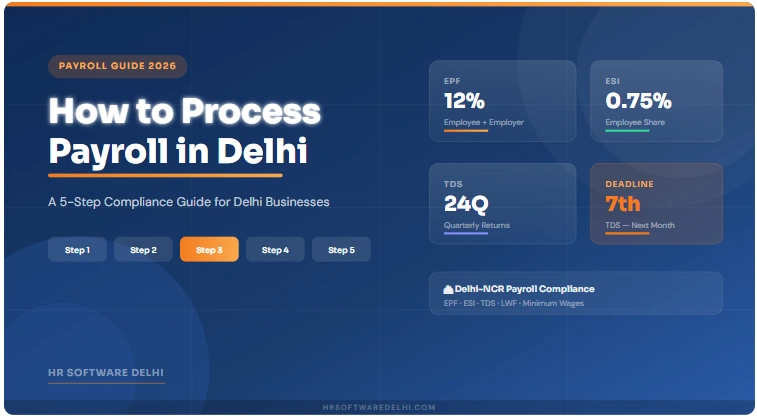
Both employee and employer contribute 12% of Basic + DA. The employer’s 12% splits into 8.33% toward EPS (pension) and 3.67% toward EPF.
| Contribution | Rate | Account |
|---|---|---|
| Employee | 12% of Basic + DA | EPF Account |
| Employer — EPS | 8.33% | Pension Fund |
| Employer — EPF | 3.67% | EPF Account |
ESI — Employee State Insurance
Applicable for employees earning up to ₹21,000 per month. Employee contributes 0.75% and employer contributes 3.25% of gross wages.
TDS — Tax Deducted at Source
TDS calculations must factor in employee investment declarations and their choice between the New and Old Tax Regime under Section 115BAC. FY 2025-26 New Regime slabs:
| Annual Income Range | Tax Rate |
|---|---|
| ₹0 – ₹3,00,000 | 0% |
| ₹3,00,001 – ₹6,00,000 | 5% |
| ₹6,00,001 – ₹9,00,000 | 10% |
| ₹9,00,001 – ₹12,00,000 | 15% |
| ₹12,00,001 – ₹15,00,000 | 20% |
| Above ₹15,00,000 | 30% |
Labour Welfare Fund
Delhi LWF contributions are made half-yearly — June 30 and December 31. Typical contribution: ₹6 from the employee and ₹12 from the employer per period.
Professional Tax is not applicable in Delhi. Unlike Mumbai, Bangalore, or Kolkata — Delhi businesses do not deduct or remit Professional Tax.
Step 4: Review and Approve Payroll
The payroll review stage is not just an internal check — it is your legal shield in case of a dispute, audit, or employee complaint. Delhi’s labour courts have seen a rise in wage-related complaints; a digitally time-stamped payroll record is your best defense.
Pre-Approval Checklist
- All salaries above applicable minimum wage thresholds
- Correct statutory deductions applied per employee
- No duplicate employee records
- Accurate LOP and attendance calculations
- Valid and active bank account details
- TDS calculations matching declared income slabs
- New joiner pro-rata salary verified
- Full and final settlement cases reviewed separately
Most Delhi organizations follow a two-level approval: HR Manager verification for data accuracy, followed by Finance Head or MD approval before the payroll is locked and disbursed.
In Delhi’s SME culture, business owners are often directly involved in payroll approvals. A system that supports mobile-based approval saves significant time on salary processing day.
Step 5: Disburse Salaries and Complete Statutory Filings
Once payroll is locked and approved, proceed with salary disbursement — then immediately begin the statutory filing cycle. Both tasks must be completed on time.
Salary Disbursement
- Transfer via NEFT (standard) or RTGS for large salary batches
- Send digital payslips via employee self-service portal or mobile app
- Avoid cash salary payments — creates compliance and audit risk
- Payslips must be individual — do not distribute via group WhatsApp
Statutory Filing Deadlines
Missing any of these deadlines results in penalties and interest charges from statutory authorities.
| Filing | Deadline | Frequency |
|---|---|---|
| TDS Deposit | 7th of next month | Monthly |
| EPF ECR | 15th of next month | Monthly |
| ESI Contribution | 21st of next month | Monthly |
| LWF Contribution | June 30 and December 31 | Half-yearly |
| TDS Return (24Q) | Month-end after each quarter | Quarterly |
| Form 16 Issuance | June 15 | Annual |
| Professional Tax | Not applicable in Delhi | — |
Manual Payroll vs Payroll Software
Many Delhi SMEs still process payroll using spreadsheets. However, as teams grow, manual systems quickly become error-prone and time-consuming.
| Task | Manual Payroll | Payroll Software |
|---|---|---|
| Monthly processing time | 6–8 hours | 30–45 minutes |
| Filing accuracy | Moderate | High |
| Compliance alerts | Manual tracking | Automatic reminders |
| Payslip distribution | Manual or WhatsApp | Digital self-service |
| Audit trail | Excel versions | Time-stamped logs |
| Multi-location support | Complex | Built-in |
HR Software Delhi automates payroll calculations, statutory filings, attendance sync, and employee self-service in a single platform built for Delhi businesses.
Conclusion
Payroll management in Delhi is less about complexity and more about discipline. When businesses maintain accurate employee records, track attendance properly, and follow a structured payroll workflow, most compliance issues disappear.
The real challenge is consistency — ensuring that the same process runs smoothly every month without exceptions. For growing companies, manual spreadsheets become difficult to manage as teams expand and compliance requirements increase.
Many Delhi businesses are therefore moving toward automated payroll platforms that calculate deductions, track compliance deadlines, and generate salary reports automatically. A reliable payroll process ultimately gives HR teams what they value most: accuracy, transparency, and peace of mind.
Frequently Asked Questions
What is payroll processing?
Payroll processing is the monthly process of calculating employee salaries, applying deductions such as EPF, ESI, and TDS, and distributing net pay to employees.
When should payroll be processed in Delhi?
Salaries are typically processed before the last working day of the month. Statutory filings follow in the next month — EPF by 15th, ESI by 21st, and TDS by 7th.
What are the main deductions in payroll for Delhi businesses?
Common payroll deductions in Delhi include EPF (12%), ESI (0.75% employee + 3.25% employer), TDS (based on income slab), and Labour Welfare Fund. Note: Professional Tax is not applicable in Delhi.
What happens if payroll compliance is delayed?
Late filings can result in penalties, interest charges, and compliance notices from statutory authorities including the EPFO, ESIC, and Income Tax Department.
Is payroll software necessary for small businesses in Delhi?
While small companies can manage payroll manually, payroll software significantly improves accuracy, automates deduction calculations, tracks compliance deadlines, and reduces the risk of statutory notices — especially as teams grow beyond 20 employees.
