
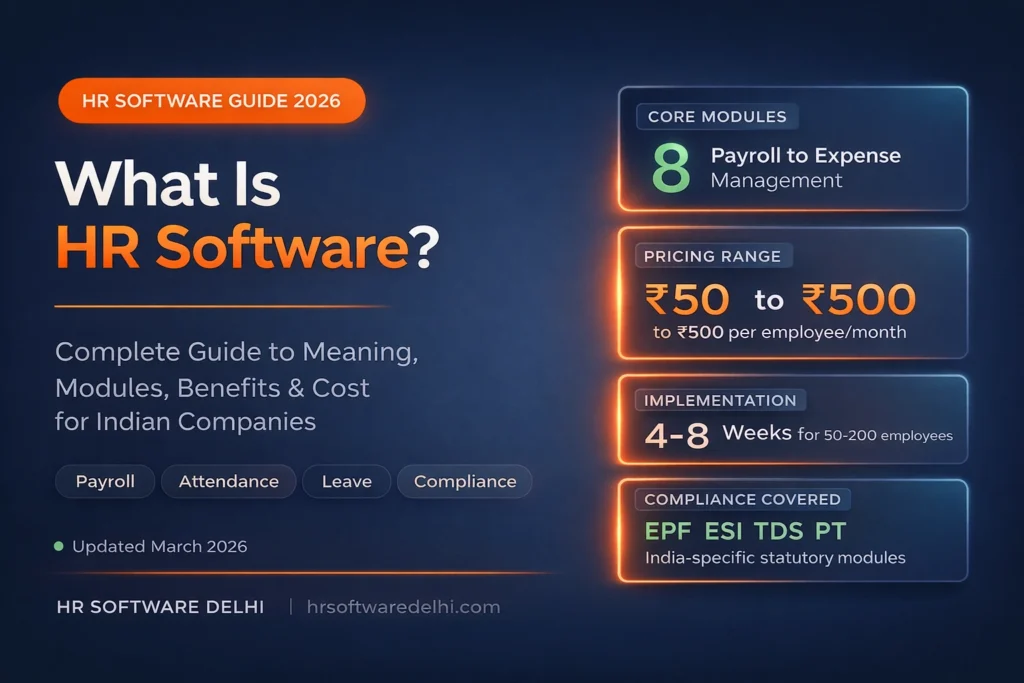
HR software is what separates companies that spend a full week on payroll from those that finish it in a few hours. At its core, it automates workforce management: calculating salaries, tracking attendance, processing leave, and staying compliant with EPF, ESI, and TDS. For any growing Indian company, it is no longer optional. Whether you are evaluating your first HRMS or replacing a system that has outgrown your needs, knowing exactly what HR software does and how to choose the right one is where it starts.
- HR software automates payroll, attendance, leave, onboarding, performance and compliance into one platform.
- HRIS stores employee data. HRMS adds payroll and operations. HCM adds talent management and analytics.
- Indian companies need HR software that handles EPF, ESI, professional tax, TDS, and minimum wages automatically.
- Pricing ranges from INR 50 to 500 per employee/month depending on features and company size.
- Implementation takes 4 to 8 weeks for a 50-200 employee company, including parallel payroll testing.
What Is HR Software?
HR software is a digital platform that automates core human resources functions – payroll processing, attendance tracking, leave management, employee onboarding, performance reviews and statutory compliance. It replaces spreadsheets, paper files and manual calculations with a centralized cloud-based system where all employee data lives in one place.
For Indian companies, HR software also handles India-specific compliance: EPF (Employee Provident Fund) contributions, ESI (Employee State Insurance) filings, professional tax calculations where applicable by state, TDS deductions under the Income Tax Act, and minimum wage enforcement under the Minimum Wages Act 1948.
Without HR software, HR teams often spend significant time each month on salary calculations, attendance checks, and compliance preparation. manually calculating salaries, cross-checking attendance registers, and preparing compliance challans. With HR software, the same process takes a few hours – with fewer errors.
HR Software vs HRMS vs HRIS vs HCM
These terms get used interchangeably, but they mean different things:
| Term | Full Form | What It Covers | Best For |
|---|---|---|---|
| HR Software | Human Resources Software | Broad term for any digital HR tool | All company sizes |
| HRIS | Human Resource Information System | Employee database, records, basic reporting | Small businesses |
| HRMS | Human Resource Management System | HRIS + payroll + attendance + leave + compliance | SMEs and mid-market |
| HCM | Human Capital Management | HRMS + talent acquisition + learning + workforce planning | Enterprise (500+) |
For most Indian companies with 20-500 employees, HRMS is the right fit. It covers everything operational – payroll, attendance, leave, compliance – without the cost and complexity of a full HCM suite. Move to HCM when you need advanced talent management, succession planning or workforce analytics.
How Does HR Software Work?
Modern HR software runs on a cloud-based SaaS model. You access it through a web browser or mobile app. In many cloud deployments, there is no local installation and minimal server maintenance for the customer. Here is the typical workflow:
- Employee onboarding – New hire data is entered once (personal details, CTC breakdown, bank account, PF/ESI numbers). This data flows automatically to every connected module.
- Attendance capture – Employees punch in via biometric device, GPS mobile app or web check-in. The system records clock-in/out, shift hours and overtime automatically.
- Leave management – Employees apply for leave through the portal or app. Managers approve in one click. Balances deduct automatically and sync with payroll.
- Payroll processing – At month-end, the system pulls attendance data, applies leave deductions, calculates gross salary, deducts EPF (12%), ESI (0.75%), professional tax and TDS, then generates payslips. See our step-by-step payroll processing guide for Delhi.
- Compliance filing – EPF ECR challan, ESI returns, PT challans and Form 16 are generated directly from payroll data.
- Reports – Real-time dashboards show headcount, attrition, attendance percentage, payroll costs and compliance status.
The key principle: data is entered once and flows everywhere. Change an employee’s department or salary structure in one place, and payroll, attendance reports and compliance filings can update automatically when the system is configured correctly.
Core Modules of HR Software
A complete HR software platform is a suite of interconnected modules. Each handles a specific function, but they all share one employee database.
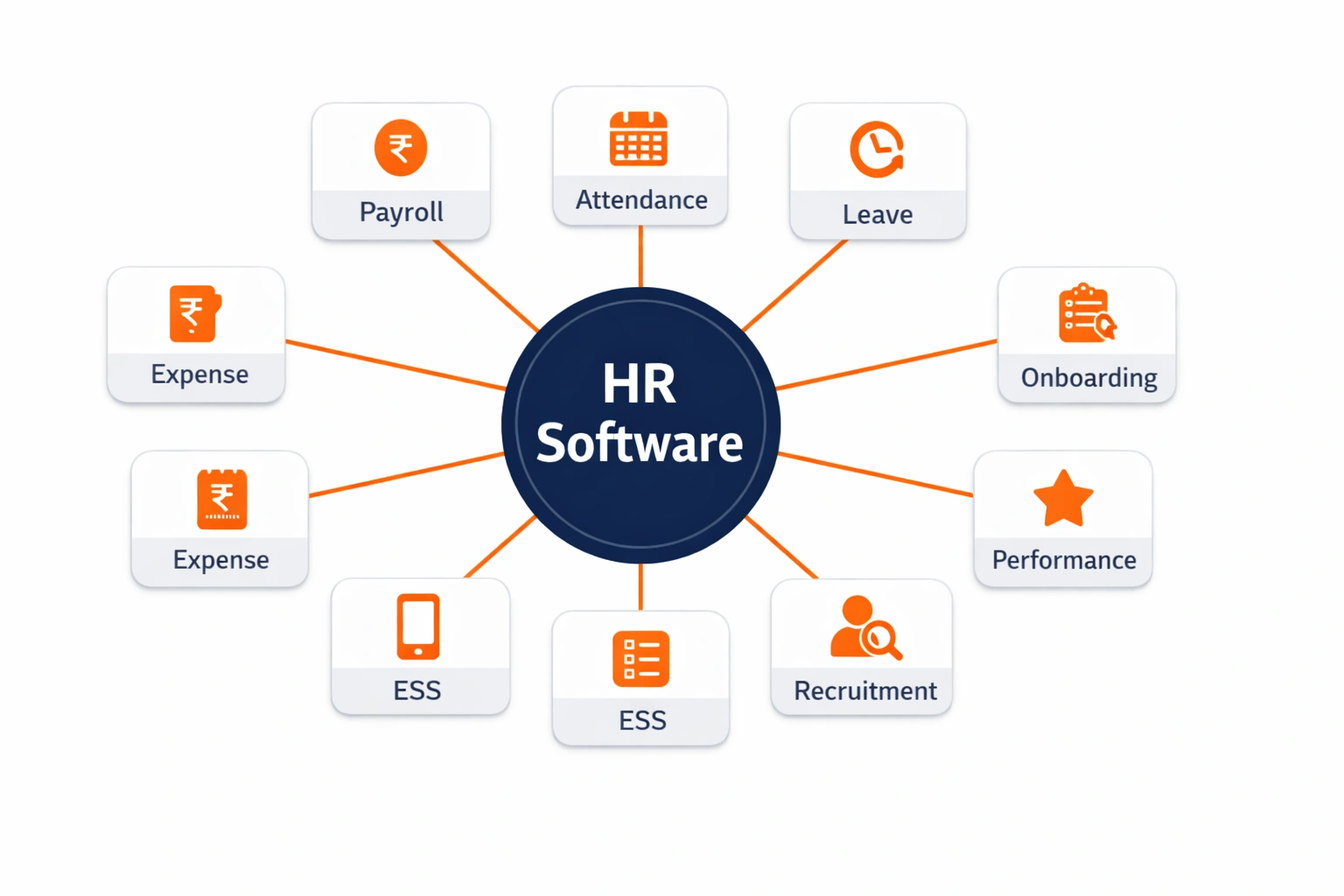
Payroll
The most critical module for Indian companies. Payroll software calculates gross-to-net salary by applying the CTC structure, attendance data, statutory deductions (EPF: 12% employee + 12% employer, ESI: 0.75% employee + 3.25% employer), professional tax where applicable under state rules, and TDS under the new or old tax regime. It generates payslips, bank transfer files and Form 16 at year-end.
Attendance and Time Tracking
Attendance management software captures daily attendance via biometric devices (Essl, ZKTeco, Realtime), GPS-based mobile punch for field staff or web check-in for office employees. Includes shift scheduling, roster management, overtime calculation and late-coming reports. Attendance data feeds directly into payroll for accurate salary computation.
Leave Management
Leave management software configures leave types (earned leave, casual leave, sick leave, maternity leave per the Maternity Benefit Act), accrual rules, carry-forward policies and leave encashment. Employees apply and managers approve through the portal. Unpaid leave automatically deducts from salary.
Onboarding
Onboarding software digitizes the joining process – offer letter generation, document collection (Aadhaar, PAN, bank details), welcome emails, training assignment and task checklists for the first 30 days. Reduces the time HR spends on each new hire from 2-3 hours to 15-20 minutes.
Performance Management
Performance management software manages KRA/KPI setting, mid-year reviews, annual appraisal cycles, 360-degree feedback and bell curve normalization. Final ratings can feed into increment and bonus calculations. Useful for companies with 50+ employees where tracking performance manually becomes impractical.
Recruitment
Recruitment software provides Applicant Tracking System (ATS) functionality – job posting to portals, resume parsing, candidate pipeline management, interview scheduling, feedback collection and offer letter generation. Reduces time-to-hire and keeps all candidate communication in one place.
Employee Self-Service (ESS)
Employee self-service portal and mobile app where employees can view payslips, check leave balance, apply for leave, download Form 16, update personal details and raise requests – without emailing or calling HR. This alone reduces routine HR queries by 50-70%.
Expense Management
Expense management software lets employees submit travel and expense claims with receipt photos. Managers approve or reject. Approved amounts automatically add to the next payroll cycle. Eliminates paper-based expense forms and speeds up reimbursements.
Benefits of HR Software for Indian Companies
Payroll accuracy and compliance
Manual payroll errors in EPF/ESI calculations result in penalty notices from EPFO and ESIC. HR software eliminates calculation mistakes and generates accurate challans and ECR files every month. For companies with 100+ employees, this alone justifies the investment.
Time savings
An HR executive processing payroll manually for 100 employees spends 3-5 full working days per month on calculations, cross-checking and report generation. With HR software, this drops to a few hours. That time redirects to hiring, employee engagement and strategic work.
Employee self-service
When employees can access their own payslips, apply for leave and update bank details without contacting HR, the department saves 20-30 routine requests per week. Employee satisfaction also improves when information is instantly accessible.
Multi-state compliance
Delhi NCR companies with offices across multiple locations need to account for state-level differences in payroll and labour-law compliance; professional tax should be checked state by state, because it is not uniformly applicable., minimum wages and Shops Act rules per state. Good HR software applies the correct state rules per employee location automatically.
Data-driven decisions
Real-time dashboards showing attrition trends, department-wise headcount, overtime costs and attendance patterns help business owners make informed decisions instead of relying on delayed manual reports.
Scalability
Cloud HR software scales with your business. Adding a new office, creating a new department or onboarding 50 employees in one month does not require additional HR staff or infrastructure changes.
HR Software for Small Business vs Enterprise
| Feature | Small Business (10-100 employees) | Enterprise (200+ employees) |
|---|---|---|
| Payroll | Basic with EPF/ESI auto-calculation | Multi-location, multi-state, multi-currency |
| Attendance | Mobile app punch, web check-in | Biometric integration, shift rosters, overtime rules |
| Performance | Basic goal tracking | KRA/KPI, 360 feedback, bell curve, increment linking |
| Recruitment | Basic job posting | Full ATS with resume parsing, pipeline management |
| Integrations | Tally export, bank file | API with SAP, Oracle, Zoho Books, QuickBooks |
| Pricing | INR 50-150/employee/month | INR 200-500/employee/month |
For many Delhi NCR SMEs (50-200 employees): A mid-range HRMS covering payroll, attendance, leave, onboarding and ESS at INR 80-200 per employee/month delivers the best ROI.
Must-Have Features Checklist
Verify these before committing to any HR software vendor in India:
- India-specific payroll with EPF, ESI, PT, LWF and TDS
- Unlimited salary components and CTC structuring
- Biometric device integration (ZKTeco, Essl, Realtime)
- GPS-based mobile attendance for field employees
- Configurable leave types and accrual rules
- Employee self-service portal and mobile app
- Automated payslip generation and email delivery
- Form 16 (Part A + Part B) generation
- EPF ECR challan and ESIC return export
- New vs old tax regime selection per employee
- Full-and-final settlement calculation
- Role-based access (HR, Manager, Employee)
- Data export in Excel/CSV for audits
- Dedicated customer support (not just chatbots)
How to Choose HR Software in India
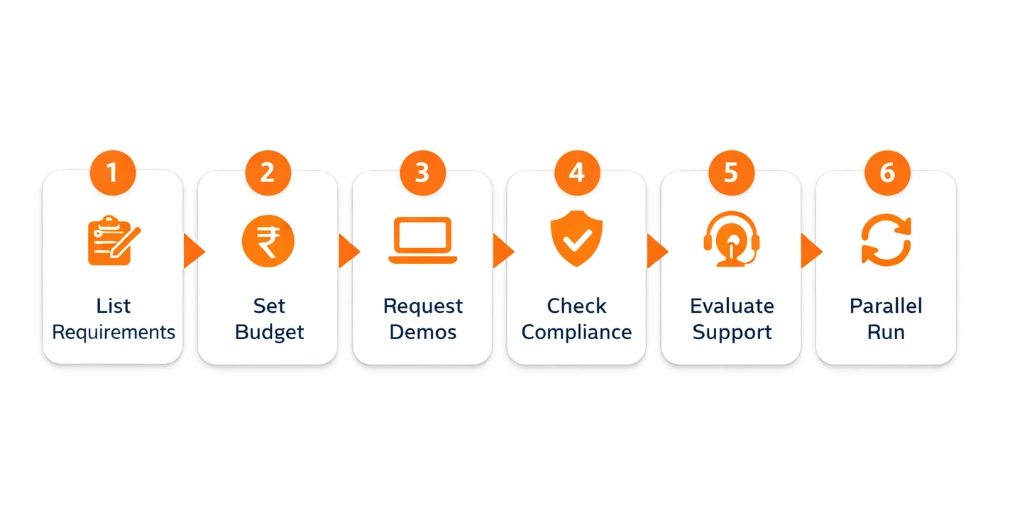
- List your 5-10 non-negotiable requirements. For most Indian companies: accurate payroll with compliance, attendance tracking, leave management and a mobile app. Do not pay for features you will not use in the next 12 months.
- Set your budget per employee. INR 50-100 for basic, INR 100-200 for mid-range, INR 200-500 for enterprise. Factor in one-time implementation charges (INR 10,000-50,000).
- Shortlist 3-4 vendors and request live demos. See our best HR software in Delhi NCR comparison for a starting point. Ask them to process payroll using your actual salary structure, integrate with your biometric device model, and generate your state-specific compliance reports.
- Check compliance update track record. Ask: How quickly do they update when payroll rules, tax rules, or statutory formats change? Do they support the latest UAN portal format? Can they generate the new ESIC return format?
- Evaluate support quality. Payroll runs on the 1st of every month without fail. Verify: Is there a dedicated account manager? What is the SLA for critical payroll issues? Is support available on salary processing days (25th-31st)?
- Run a parallel payroll for one month. Process salaries on both your old method and the new software. Compare results. Fix discrepancies before going fully live.
HR Software Implementation Timeline
| Week | Phase | Activities |
|---|---|---|
| 1 | Data Collection | Employee master data, salary structures, leave balances, attendance history |
| 2 | Configuration | Company setup, leave policies, salary components, departments, holidays |
| 3 | Compliance Setup | EPF registration, ESI codes, state-wise PT slabs, TDS regime per employee |
| 4 | Parallel Run | Process payroll on old + new system, compare and reconcile differences |
| 5-6 | Training | HR team training, manager approval training, employee self-service walkthrough |
| 7-8 | Go Live | First live payroll, biometric integration, app rollout, hypercare support |
Common mistakes: Skipping the parallel run (causes salary errors on go-live), not migrating leave balances correctly, and not training managers on approval workflows before employees start using the system.
HR Software Cost in India (2026)
| Tier | Price (per employee/month) | What You Get |
|---|---|---|
| Starter | INR 50-80 | Payroll + basic attendance + leave. Suits 10-30 employees. |
| Growth | INR 80-150 | Full HRMS: payroll, attendance, leave, onboarding, ESS app. |
| Professional | INR 150-250 | Adds performance management, recruitment and analytics. |
| Enterprise | INR 250-500 | Full HCM, dedicated support, custom integrations, SLA. |
Watch for hidden costs: Implementation charges (INR 10,000-50,000 one-time), biometric device integration (INR 5,000-15,000 per device), training and data migration fees. Always ask for an all-inclusive quote. View our pricing for transparent rates.
ROI example: A 100-employee company at INR 120/employee/month spends INR 1,44,000 per year. If it saves one HR executive 10 days per month in manual work (valued at INR 20,000/month), the ROI exceeds 160% in year one – before accounting for compliance penalty savings.
HR Software for Delhi NCR Companies
Companies in Delhi NCR – covering Delhi, Noida, Gurugram, Faridabad and Ghaziabad – face specific challenges that generic HR software often handles incorrectly:
- Professional tax: Professional tax should be verified carefully by work location, because it is not uniformly applicable across Delhi NCR.
- Minimum wages: Delhi minimum wages are revised twice yearly (October and March). Software must auto-update slabs to comply with the Minimum Wages Act 1948.
- Shops and Establishments Act: Delhi, Haryana and UP each have separate labour laws with different working hours, overtime rules and weekly off requirements.
- High attrition: IT, BPO and retail sectors in Delhi NCR see 25-40% annual turnover. Automated full-and-final settlement and experience letter generation save significant HR time.
If your company operates across the Delhi NCR region, look for HR software in Noida and Delhi NCR that supports multi-state compliance with location-based rule application where needed.
Final Word
HR software is not a luxury for large enterprises anymore. Any Indian company with 10 or more employees stands to save time, reduce payroll errors, and stay compliant with EPF, ESI, TDS, and state-specific labour laws by switching from manual processes to a purpose-built HRMS. The key is choosing software that handles India-specific compliance accurately and scales with your team as you grow.
Looking for HR software built specifically for Delhi NCR companies? Our platform handles multi-state payroll across Delhi, Noida, and Gurugram with zero manual compliance work. Book a free demo and see it running with your own salary structure.
Frequently Asked Questions
What is the difference between HRMS and HR software?
HR software is a broad term for any digital tool managing HR tasks. HRMS is a specific type of HR software that integrates payroll, attendance, leave and compliance into one platform. All HRMS is HR software, but not all HR software is a full HRMS.
Is HR software necessary for small businesses?
Yes. Even a 10-employee company must handle EPF contributions, ESI filings, TDS deductions and attendance records. Manual errors in these result in government notices and penalties. Cloud HR software at INR 50-100/employee/month makes compliance affordable for small businesses.
Can HR software handle multi-state payroll in India?
Yes. This is critical for Delhi NCR companies with staff in Delhi, Haryana and Uttar Pradesh, where professional tax, minimum wages and labour laws differ by state. Good HR software auto-applies state-specific rules per employee work location.
How long does HR software implementation take?
4-8 weeks for a 50-200 employee company. This includes data migration, system configuration, compliance setup, parallel payroll run and training. Larger companies with ERP integrations may need 3-6 months.
Does HR software integrate with Tally?
Most Indian HR software supports payroll journal export in Tally-compatible format. Some also offer API integration with Zoho Books, QuickBooks and SAP for automatic data sync between HR and accounts departments.
What is the cost of HR software in India?
INR 50-500 per employee per month depending on features and company size. Basic payroll starts at INR 50-80. Full HRMS with attendance, leave and ESS costs INR 80-200. Enterprise HCM with analytics ranges INR 250-500.
Is cloud HR software safe for employee data?
Reputable HR software vendors use 256-bit SSL encryption, role-based access controls, regular backups and data centers with ISO 27001 certification. Cloud is generally more secure than storing employee data in local Excel files that anyone with laptop access can copy.
Can I switch from one HR software to another?
Yes, but plan for 4-6 weeks of data migration. Export all employee records, salary history, leave balances and compliance data from the old system. Run parallel payroll for at least one month before fully switching to avoid errors.
