
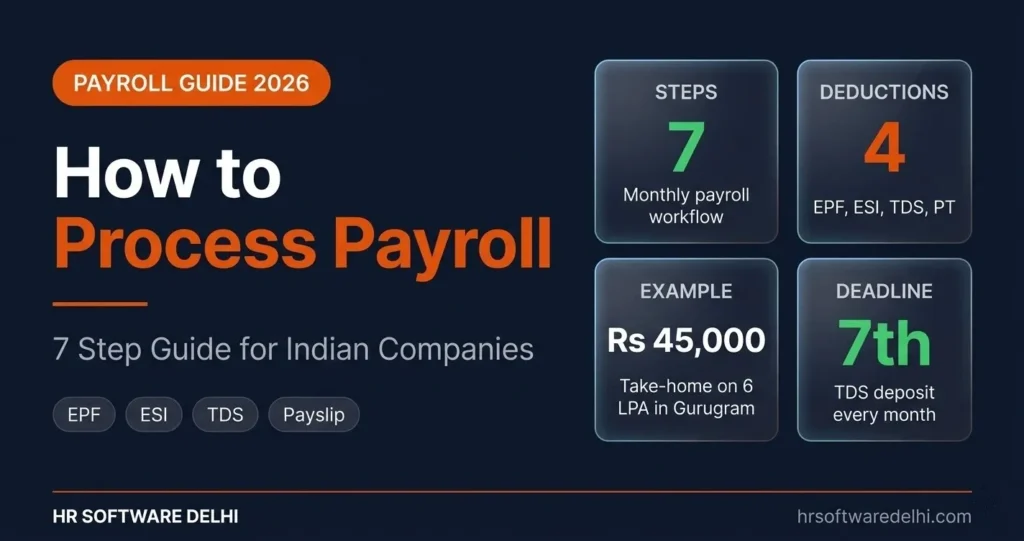
A single miscalculated allowance or missed tax deadline can cost an Indian company thousands in penalties. Learning how to process payroll correctly means following a structured system to calculate employee salaries, apply deductions, transfer payments, and complete statutory filings on time. In India, the payroll process includes EPF, ESI, TDS, and professional tax compliance, making it more than just salary calculation. It is a regulated financial workflow every business must follow. Once the run is approved, your payroll reports give the full audit trail.
- The payroll process step by step, ensures accurate salary and compliance.
- Most payroll errors start before the actual payroll calculation.
- Payroll processing in India includes EPF, ESI, TDS, and PT deductions.
- A clear salary breakdown improves employee trust.
- Automated payroll processing reduces manual errors and compliance risk.
Before You Start: Payroll Setup Checklist
Before you start the actual payroll process, it is important to set up the foundation correctly. Most payroll errors happen due to missing setup, not calculation mistakes.
- Company PAN and TAN registration completed
- EPF establishment code obtained (mandatory once you hit 20 employees)
- ESI registration number issued (mandatory for 10 employees)
- Professional tax registration for applicable states (Delhi has none, Haryana, and UP are mandatory)
- Employee salary structure prepared with full CTC breakup for every role
- Employee PAN, Aadhaar, and bank account details collected and verified
- Reliable attendance tracking system is operational
- Tax regime declarations (new vs old) collected from every employee at onboarding
- Formal payroll calendar approved by finance and HR
Once your setup is complete, you can move to the actual payroll processing steps. Following a fixed sequence every month ensures accuracy and compliance.
How to Process Payroll: 7 Steps (Payroll Process Step by Step)
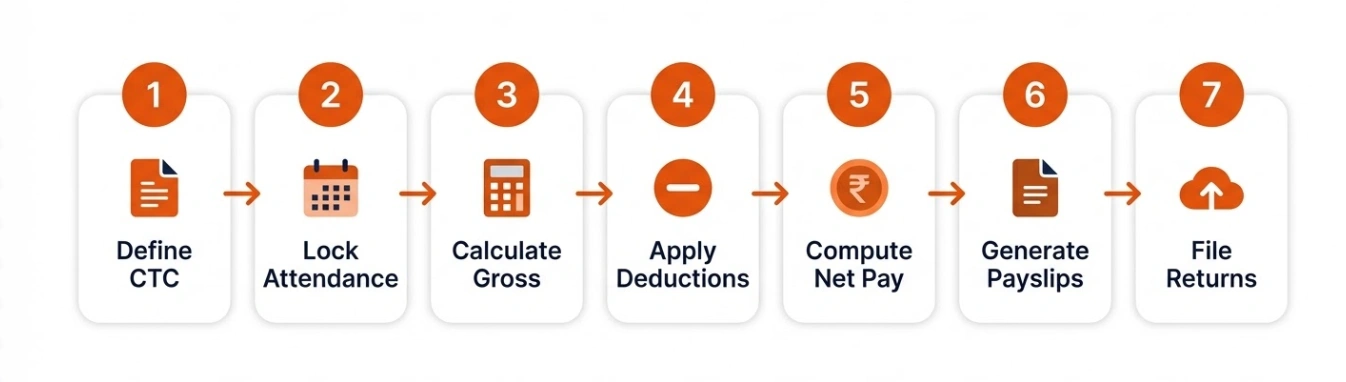
- Set up salary structure and CTC breakup
The first step in the payroll process step by step, is defining a correct salary structure, as it directly impacts payroll calculation, deductions, and compliance. Basic (Basic salary is typically structured between 40–50% of CTC in many companies, though it may vary based on policy) salary is critical because it determines EPF contribution, gratuity, and overtime calculations. Our complete payroll guide explains each component in detail. An incorrectly set basic salary cascades errors through every payroll run. Use our CTC to in-hand calculator to model different structures before finalizing.
- Collect attendance and leave data
Attendance data is the basis of accurate payroll calculation and must be finalized before starting payroll processing. Confirm Loss of Pay days, approved overtime, and half days. Without locked data, no calculation (manual or software) can produce correct earnings. This step must be fully complete before touching any numbers. Accurate leave records prevent salary disputes later.
- Calculate gross salary
Gross salary calculation is a key stage in the payroll processing steps, as all deductions depend on it. The formula:
Gross Salary = Basic + HRA + DA + Special Allowance + Variable Pay
Prorate for any LOP days. For example, if an employee has 2 LOP days in a 30-day month, their basic salary for that month is Basic x (28/30). This prorated figure carries forward into every deduction calculation.
- Calculate statutory deductions
TDS is generally required to be deposited by the 7th of the following month, as per current income tax rules. This is the most compliance-heavy step. Four deductions apply:
- EPF: 12% of Basic + DA from the employee. Employer matches with another 12%. Deposited via ECR challan.
- ESI: 0.75% of gross from employee, 3.25% from employer. Applies only if the monthly gross is Rs 21,000 or below.
- TDS: Estimated annual tax based on employee declarations, divided by 12 for monthly deduction. Must be deposited by the 7th of the following month. For Delhi employees, see our detailed TDS on the salary guide.
- Professional Tax: Delhi charges nil. Haryana charges Rs 200/month for salaries above Rs 15,000. UP varies by designation.
- Calculate net salary (take-home pay)
This step finalizes the salary calculation process, determining the employee’s take-home pay. This is the amount the employee actually receives:
Net Pay = Gross Salary – EPF – ESI – TDS – Professional Tax
This final figure is what hits the bank account. Every payslip must show both the gross and net figures with a clear breakdown of each deduction so employees understand exactly where their money goes.
- Generate payslips and transfer salaries
Salary payments are typically required within defined timelines under the Payment of Wages Act, depending on company size. Salary transfers are done via NEFT/RTGS or through a bank file upload from your payroll software. Under the Payment of Wages Act, companies with fewer than 1,000 employees must credit salaries by the 7th of the following month. Companies with 1,000+ employees get until the 10th.
- File statutory returns and deposit taxes
File statutory returns and deposit taxes.
- TDS: Deposit by 7th of next month. File Form 24Q quarterly.
- EPF: Generate ECR challan and deposit by 15th of next month.
- ESI: Payment due by 15th of next month.
- Form 16: Issue to all employees by 15 June annually.
Late TDS filing may attract penalties under Section 234E, calculated per day of delay, along with applicable interest. Late EPF attracts 5% to 25% damages depending on delay. For the Delhi-specific version of this process, see our payroll processing in Delhi guide.
Payroll Processing: Worked Example (Rs 6 LPA)
Here is a practical example of how to process payroll step by step for a ₹6 LPA salary in India.
Key facts:
- Basic at 40% of CTC, HRA at 50% of Basic
- Gross salary exceeds Rs 21,000/month, so ESI does not apply
- Haryana professional tax: Rs 200/month
- Under the new tax regime, taxable income after Rs 75,000 standard deduction is Rs 4,96,200. This is below Rs 7,00,000, so Section 87A rebate applies. TDS is zero.
| Component | Monthly (Rs) | Annual (Rs) |
|---|---|---|
| Basic Salary (40%) | 20,000 | 2,40,000 |
| HRA (50% of Basic) | 10,000 | 1,20,000 |
| Special Allowance | 17,600 | 2,11,200 |
| Gross Salary | 47,600 | 5,71,200 |
| EPF Employer (12% of Basic) | 2,400 | 28,800 |
| Total CTC | 50,000 | 6,00,000 |
| EPF Employee Deduction (12%) | 2,400 | 28,800 |
| Professional Tax (Haryana) | 200 | 2,400 |
| TDS (New Regime, 87A rebate) | 0 | 0 |
| Total Deductions | 2,600 | 31,200 |
| Net Take-Home Pay | 45,000 | 5,40,000 |
Math check: CTC (6,00,000) = Gross (5,71,200) + EPF Employer (28,800). Net = Gross (47,600) minus EPF (2,400) minus PT (200) = Rs 45,000/month.
A structured payroll calendar is essential for maintaining payroll compliance in India and avoiding penalties.
| Date | Task | Authority |
|---|---|---|
| 1st of month | Lock attendance and leave for prior month | Internal HR |
| 7th of next month | Pay salaries and deposit TDS | Income Tax Department |
| 15th of next month | Deposit EPF via ECR challan | EPFO |
| 15th of next month | Deposit ESI contributions | ESIC |
| Quarterly | File Form 24Q (salary TDS return) | Income Tax Department |
| 15 June (annually) | Issue Form 16 to all employees | Income Tax Department |
Common Payroll Processing Mistakes
These common errors can break your entire payroll process in India:
- Running payroll before locking attendance: Leads to incorrect payouts and messy adjustments in the next cycle.
- No proration for mid-month joiners: Paying a full month to someone who joined on the 15th inflates costs and confuses records.
- Ignoring March investment declaration updates: Results in inflated TDS in the final quarter and frustrated employees claiming manual refunds.
- Applying the wrong tax regime: Calculating TDS under old regime when the employee opted for new regime produces incorrect net figures and compliance issues.
- Wrong bank file format: Uploading an incorrect Excel format to the corporate banking portal bounces all salary transfers.
- No parallel run when switching software: Moving to a new system without comparing results against the old one hides critical calculation errors that only surface months later.
Many of these errors happen due to manual handling. This brings up an important question: Should payroll be managed manually or through software?
Manual vs Software: Which Payroll Method Is Right?
Manual processing works for very small teams where one person can track everything in a spreadsheet. Once headcount crosses 10 employees, the compliance risk outweighs the cost savings. Payroll software automates calculations, applies the latest tax rates automatically, generates bank files, and files returns directly. For growing companies in Delhi, Noida, and Gurugram, software is not a convenience. It is a compliance requirement.
| Factor | Manual (Excel) | Payroll Software |
|---|---|---|
| Accuracy | Prone to formula errors | Rule-based, automated |
| Time per cycle | 8 to 10 hours | Under 1 hour |
| Compliance | Manual tracking of deadlines | Auto reminders and e-filing |
| Cost | Free upfront, high penalty risk | INR 50 to 150/employee/month |
| Best for | Under 10 employees | 10+ employees |
Final Word
Processing payroll in India is not a single click. Understanding how to process payroll correctly helps businesses avoid penalties, ensure compliance, and maintain employee trust. It is a disciplined monthly workflow where every salary figure feeds directly into statutory returns. When you understand how to process payroll correctly, from setting the CTC breakup to filing Form 24Q, penalties disappear and employees stay satisfied.
If your business in Delhi NCR needs a faster, error-free way to handle payroll, the right software handles every step while keeping you in control. Book a free demo and see it work with your own salary data.
Frequently Asked Questions
How do you process payroll step by step?
Start by fixing each employee’s CTC breakup, then lock attendance for the month. Calculate gross salary, apply EPF, ESI, TDS, and professional tax deductions, compute the net pay, transfer salaries via bank file, and file all statutory returns within their deadlines. Following this seven-step sequence every month ensures complete compliance.
What is the deadline for salary payment in India?
Under the Payment of Wages Act, companies with up to 1,000 employees must credit salaries by the 7th of the following month. Larger establishments have until the 10th. Missing this deadline is a legal violation that can result in employee complaints and labor department action.
How is EPF calculated during payroll?
Employee EPF equals 12% of Basic salary plus Dearness Allowance, deducted from the employee’s gross pay. The employer contributes an equal 12%, split between EPF (3.67%) and EPS (8.33%). Both shares must be deposited via the ECR challan by the 15th of the following month.
What happens if you miss the TDS deposit deadline?
A late fee of Rs 200 per day under Section 234E starts immediately, and interest of 1.5% per month applies until the deposit is made. Repeated delays invite scrutiny from the Income Tax Department and can lead to prosecution for persistent defaulters.
Can I process payroll on Excel?
Yes, but only for very small teams. Spreadsheets lack automated tax updates, make version control difficult, and cannot generate government-ready files like Form 24Q or EPF ECR challans. Errors compound quickly once headcount rises past 10 employees, making the compliance risk far greater than the cost of software.
How often should payroll be processed in India?
The standard payroll cycle in India is monthly, aligned with statutory deadlines for EPF (15th), ESI (15th), and TDS (7th). Some project-based companies run fortnightly cycles, but monthly remains the most common and compliance-friendly approach across industries.
