
Every Indian company follows a payroll cycle, but most HR teams do not have a clearly defined one. They collect attendance on different dates, apply deductions inconsistently, and miss filing deadlines because no one mapped the actual sequence of tasks. The result is delayed salaries, wrong EPF deposits, missed TDS deadlines, and frustrated employees asking where their payslips are. Whether you run a 20-person startup in Noida or a 300-employee manufacturing unit in Gurugram, getting the payroll cycle right is the foundation of every other HR process.
- Definition: A payroll cycle is the fixed, recurring time period for which employee salaries are calculated, processed, and disbursed.
- Types: Indian companies commonly use weekly, biweekly, semi-monthly, or monthly payroll cycles, with monthly being the most prevalent.
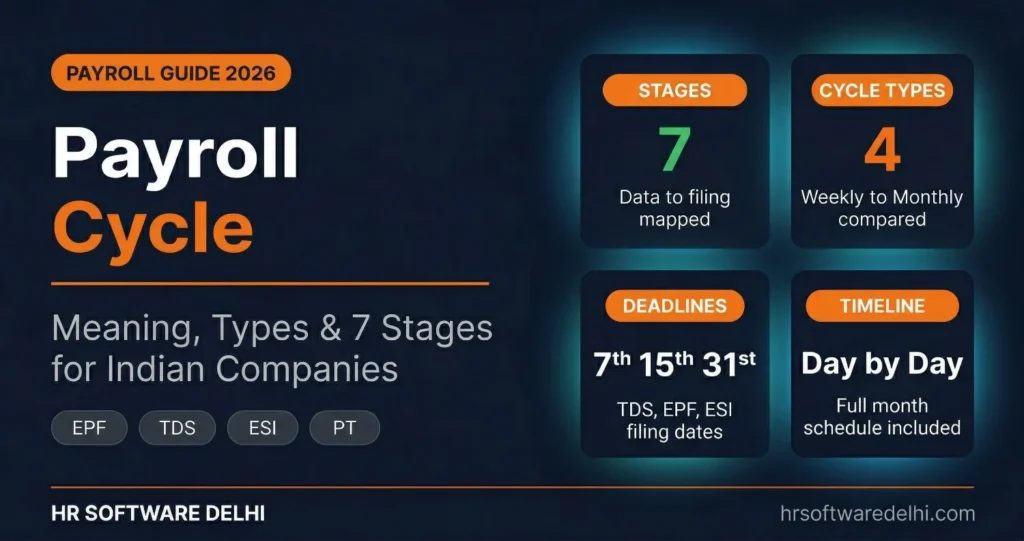
- 7 stages: This post maps each stage of the payroll cycle from data collection to compliance filing with exact timelines and deadlines.
- Compliance deadlines: EPF by the 15th, TDS by the 7th, ESI by the 15th. Missing these triggers penalties that compound every month.
- Choosing the right cycle: The best payroll frequency depends on workforce type, cash flow, and industry. This post covers how to decide.
What Is a Payroll Cycle?
A payroll cycle is the fixed, recurring schedule that determines when employee salaries are calculated and paid. It defines the start date and end date of each pay period, the cutoff for attendance and leave data, the processing window for salary computation, and the actual pay date when money reaches employee bank accounts. In simple terms, the payroll cycle answers one question: how often do you pay your employees, and what sequence of steps happens each time?
For Indian businesses, the payroll cycle also includes a compliance layer that most global guides overlook. Each cycle must account for EPF contributions at 12 percent, ESI deductions where applicable, TDS computation under the chosen tax regime, state-wise Professional Tax, and Labour Welfare Fund where mandated. Therefore, the payroll cycle is not just about paying salaries. It is about paying them accurately, on time, and with every statutory obligation fulfilled before the government-mandated deadlines.
Types of Payroll Cycles in India
Indian companies use four main payroll frequencies. However, the monthly cycle dominates because it aligns with how statutory compliance deadlines are structured in India.
| Payroll Cycle | Frequency | Common In | Best For |
|---|---|---|---|
| Weekly | Every 7 days | Construction, daily wage, contract labour | Companies with daily wage or piece-rate workers |
| Biweekly | Every 14 days | Rare in India, some MNCs follow US parent cycle | Indian subsidiaries of global companies |
| Semi-monthly | Twice a month (1st and 16th) | Sales teams with advance and settlement structure | Companies paying advance salary mid-month |
| Monthly | Once a month (usually last working day) | Over 90 percent of Indian companies | Salaried employees across all industries |
The monthly payroll cycle is the standard in India because EPF, ESI, and TDS filing deadlines all operate on a monthly basis. Running a different frequency creates additional reconciliation work. As a result, most companies in Delhi NCR process payroll between the 25th and last day of each month, with salary credited by the 1st or 7th of the following month.
7 Stages of a Monthly Payroll Cycle
Every monthly payroll cycle follows the same core stages, regardless of company size. The difference between a smooth cycle and a chaotic one is whether each stage has clear ownership, cutoff dates, and automated checks. Here is how each stage works for Indian businesses.
Stage 1: Define Pay Period and Cutoff Dates
The payroll cycle starts by setting the pay period. Most Indian companies use 1st to last day of the month as the standard period. You also need to define the attendance cutoff date, which is typically the 25th or 28th. Any attendance data, leave applications, or overtime entries after this date roll into the next cycle. Setting a clear cutoff prevents last-minute corrections that delay the entire process.
Stage 2: Collect Attendance and Leave Data
Once the cutoff hits, the HR team pulls attendance records from the attendance management system. This includes biometric logs, mobile punch-ins, shift hours, overtime, late marks, and half-day entries. Simultaneously, the leave management software provides approved leave, unapproved absences, and Loss of Pay (LOP) days. For companies with employees across Delhi, Noida, and Gurugram, this stage must account for different shift patterns and location-wise attendance rules.
Stage 3: Calculate Gross Salary
With attendance data finalized, the system calculates gross salary for each employee. Gross salary equals Basic Salary plus HRA plus Dearness Allowance plus Special Allowance plus any other earnings like LTA, performance bonus, arrears, or reimbursements. LOP days reduce the gross proportionally. For example, if an employee earning Rs 50,000 gross monthly has 2 LOP days in a 30-day month, the adjusted gross becomes Rs 46,667. Getting this calculation right is critical because every subsequent deduction depends on it.
Stage 4: Apply Statutory Deductions
This is the compliance-heavy stage where Indian payroll differs significantly from global payroll. The following deductions must be calculated and applied accurately every single cycle:
- EPF (Employee Provident Fund): 12 percent of Basic plus DA from employee, matched by 12 percent employer contribution. Applicable for all establishments with 20 or more employees.
- ESI (Employee State Insurance): 0.75 percent from employee and 3.25 percent from employer, applicable for employees earning gross wages up to Rs 21,000 per month.
- TDS (Tax Deducted at Source): Computed based on the employee’s annual income estimate, tax regime chosen (old or new), and investment declarations submitted under Section 80C, 80D, and other applicable sections.
- Professional Tax: Varies by state. Delhi charges zero PT, Haryana deducts Rs 200 per month for salaries above Rs 15,000, and Uttar Pradesh rates vary by designation.
- LWF (Labour Welfare Fund): Applicable in some states. Haryana charges Rs 25 from employee and Rs 75 from employer per half year in June and December.
Automating this stage through payroll software eliminates the risk of applying wrong rates, missing threshold changes, or filing incorrect returns.
Stage 5: Compute Net Pay
Net pay equals gross salary minus all deductions. This is the amount that actually reaches the employee’s bank account. The payroll processing system should also generate a clear payslip showing every component: earnings on one side, deductions on the other, and the final net amount at the bottom. Additionally, net pay should be expressed in words on the payslip for formal documentation purposes.
Stage 6: Process Bank Transfers and Payslips
Once net pay is finalized for all employees, the system generates the bank transfer file. This file contains employee names, bank account numbers, IFSC codes, and net amounts. HR or finance uploads this file to the company’s bank portal for batch processing. Simultaneously, individual payslips are generated and distributed to employees through the self-service portal or email. Salary should be credited by the 1st or 7th of the following month as per your company policy.
Stage 7: File Statutory Returns
The payroll cycle does not end when salary is credited. The final stage is filing all statutory returns within the government-mandated deadlines. Missing these deadlines triggers penalties that compound over time.
| Filing | Deadline | Authority | Penalty for Delay |
|---|---|---|---|
| TDS Deposit | 7th of next month | Income Tax Department | 1.5% per month interest + Rs 200/day late fee |
| EPF Challan (ECR) | 15th of next month | EPFO | 5% to 25% damages based on delay duration |
| ESI Contribution | 15th of next month | ESIC | 12% per annum on delayed amount |
| Form 24Q (Quarterly TDS) | 31st of month after quarter | Income Tax Department | Rs 200/day under Section 234E |
| Form 16 (Annual) | 15th June | Income Tax Department | Rs 100/day per employee |
Payroll Cycle Timeline: Month at a Glance
Here is a practical day-by-day timeline showing when each task should happen within a standard monthly payroll cycle. Following this timeline ensures nothing falls through the cracks.
| Date | Task | Owner |
|---|---|---|
| 1st to 25th | Attendance tracking, leave approvals, overtime logging | HR + Managers |
| 25th | Attendance cutoff. Finalize all regularizations and corrections | HR |
| 26th to 27th | Calculate gross salary, apply LOP, verify variable inputs | Payroll Team |
| 27th to 28th | Apply statutory deductions (EPF, ESI, TDS, PT). Review for accuracy | Payroll Team |
| 28th to 29th | Finalize net pay. Generate bank file and payslips | Payroll + Finance |
| 30th or 1st | Upload bank file. Credit salaries to employee accounts | Finance |
| 1st to 5th | Distribute payslips via portal or email | HR |
| By 7th | Deposit TDS with Income Tax Department | Finance |
| By 15th | File EPF ECR challan and ESI contribution | Finance / HR |
How to Choose the Right Payroll Cycle for Your Company
The right payroll frequency depends on three factors: workforce type, cash flow, and compliance complexity. Consider the following when deciding.
- Workforce composition: If most employees are salaried, monthly works best. If you have daily wage workers, construction labour, or gig workers, weekly or semi-monthly may be necessary to meet Payment of Wages Act requirements.
- Cash flow predictability: Monthly payroll requires one large payout per month. If your business has uneven revenue (seasonal, project-based), semi-monthly splits the cash burden. However, this doubles the compliance processing effort.
- Multi-state operations: Companies with employees across Delhi, Haryana, and UP already handle different PT and LWF rules. Adding a non-standard payroll frequency increases reconciliation complexity. Therefore, most Delhi NCR businesses stick with the monthly cycle to keep compliance manageable.
- Industry norms: IT and services companies almost universally use monthly. Manufacturing and construction may need weekly cycles for contract workers while maintaining monthly for permanent staff. In such cases, running dual payroll cycles is common.
- Software capability: Ensure your HR software supports the frequency you choose. Not all systems handle weekly or biweekly cycles with Indian compliance rules built in.
Common Payroll Cycle Mistakes Indian Companies Make
- No fixed attendance cutoff date: Without a clear cutoff, HR keeps accepting corrections until the last minute. As a result, payroll processing starts late every month and salary credits get delayed.
- Processing payroll before leave approvals are finalized: Unapproved leave requests sitting with managers cause LOP miscalculations. Subsequently, employees receive incorrect salary and HR spends the next month processing corrections.
- Applying EPF on gross salary instead of Basic plus DA: This is one of the most common calculation errors. EPF contribution should be 12 percent of Basic plus Dearness Allowance, not 12 percent of gross salary.
- Missing the TDS deposit deadline on the 7th: Interest at 1.5 percent per month starts immediately after the 7th. Over a year, this adds up to significant penalties that are entirely avoidable.
- Not updating tax regime mid-year: When employees switch from old to new tax regime, TDS calculations must be adjusted immediately. Failing to do so creates discrepancies in Form 16 at year end.
- Ignoring state-wise differences for NCR employees: A company with offices in Delhi and Gurugram cannot apply the same PT rules to all employees. Delhi has zero PT, while Haryana deducts Rs 200 per month. This mistake triggers compliance notices from state authorities.
- No parallel validation when switching payroll systems: Moving from Excel to automated payroll without running both in parallel for at least one cycle risks salary errors that damage employee trust.
Final Word
A well-defined payroll cycle is the backbone of accurate salary processing, statutory compliance, and employee trust. Every stage, from attendance cutoff to EPF filing, must happen on schedule with clear ownership. When any step slips, the entire cycle breaks down and the cost shows up as penalties, wrong salaries, and hours of manual correction work.
For Delhi NCR businesses managing teams across multiple states and office locations, automating the payroll cycle through reliable payroll software is the most practical way to eliminate manual errors and meet every compliance deadline consistently. Book a free demo to see how payroll automation fits your current team size and cycle.
Frequently Asked Questions
What is a payroll cycle?
A payroll cycle is the fixed, recurring time period for which employee salaries are calculated and paid. It includes the pay period (usually 1st to last day of the month), the attendance cutoff, salary computation, deduction application, bank transfer, and statutory filing. Most Indian companies follow a monthly payroll cycle because it aligns with EPF, ESI, and TDS deadlines.
What are the types of payroll cycles in India?
The four types are weekly, biweekly, semi-monthly, and monthly. Monthly is used by over 90 percent of Indian companies because statutory filings like EPF and TDS operate on a monthly schedule. Weekly cycles are common in construction and daily wage sectors, while biweekly is rare and mainly seen in MNC subsidiaries following their parent company’s schedule.
What is the difference between pay period and payroll cycle?
A pay period is the specific date range for which salary is calculated, such as March 1 to March 31. The payroll cycle, on the other hand, includes the entire sequence of steps: data collection, salary calculation, deduction application, bank transfer, payslip distribution, and statutory filing. In other words, the pay period is one component within the broader payroll cycle.
When should payroll be processed each month?
Most Indian companies set the attendance cutoff around the 25th, process payroll between the 26th and 29th, and credit salaries by the 30th or 1st of the following month. TDS must be deposited by the 7th, and EPF and ESI challans must be filed by the 15th. Sticking to this timeline ensures compliance deadlines are met without last-minute pressure.
What happens if EPF is deposited late?
Late EPF deposit attracts damages ranging from 5 percent for delays up to 2 months, to 25 percent for delays exceeding 6 months. Additionally, interest at 12 percent per annum applies on the delayed amount. Persistent non-compliance can lead to prosecution under the EPF and Miscellaneous Provisions Act, 1952.
Can a company run two different payroll cycles?
Yes, companies with mixed workforce types often run dual cycles. For example, a manufacturing company in Faridabad may process weekly payroll for contract workers on the factory floor while running monthly payroll for permanent office staff. However, this increases compliance complexity because statutory filings still happen monthly regardless of pay frequency.
How does automation improve the payroll cycle?
Automation eliminates manual steps like attendance data collection, salary computation, deduction calculation, and bank file generation. The system pulls data directly from attendance and leave modules, applies all statutory rules automatically, and generates payslips and filing-ready documents in one flow. As a result, companies reduce processing time from days to hours and virtually eliminate calculation errors.
What is the best payroll cycle for startups in Delhi NCR?
Monthly is the best choice for most startups because it requires the least compliance overhead and aligns with how EPF, ESI, and TDS deadlines work. Set the cutoff on the 25th, process by the 28th, and credit by the 1st. This gives your team enough buffer to handle corrections without missing statutory deadlines.
