
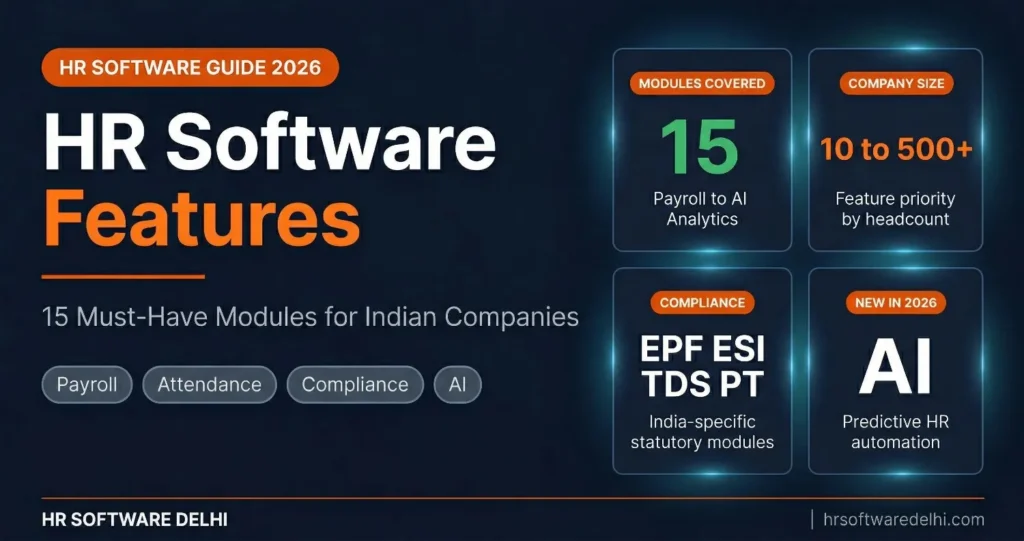
HR software features often look impressive in a demo, but most Indian companies buy a system after seeing only payroll and attendance, then struggle when they need compliance depth, multi-location control, or employee self-service. That gap shows up in delayed salary processing, missed statutory filings, manual leave tracking, and confused managers across Delhi NCR offices. The right platform should not just store employee data. It should run payroll, attendance, compliance, and daily HR workflows on one connected system built for how Indian businesses actually operate.
- 15 Modules Covered: Every essential HR software feature from payroll automation and statutory compliance to AI-powered analytics for 2026.
- India-Specific Compliance: Why localized HRMS features for EPF, ESI, TDS, and state-wise Professional Tax are non-negotiable for Indian employers.
- Size-Based Priority: A clear feature matrix showing which modules matter for companies with 10 to 50, 50 to 200, and 200 to 500 employees.
- Global vs Indian Gap: Eight critical features that international HR platforms consistently miss for Indian payroll and labour law compliance.
- Delhi NCR Context: Practical use cases for teams spread across Delhi, Noida, Gurugram, and Faridabad with different state compliance rules.
- Evaluation Framework: Five steps to test HR software modules before buying, instead of relying on a polished sales demo.
What Are HR Software Features?
HR software features are the functional modules and digital capabilities that make up a complete HRMS platform. These interconnected tools help HR teams manage attendance, payroll, leave, hiring, documents, reviews, approvals, and reporting through one system. When companies compare HRMS features, they are really evaluating how complete, usable, and India-ready that platform is for their specific workforce size and compliance requirements.
For businesses operating in India, good HR software functionality connects payroll automation, attendance tracking, leave management, compliance automation, recruitment, onboarding, performance appraisal, and HR analytics on a single platform. This replaces scattered Excel sheets, email-based approvals, and manual follow-ups that most growing companies still rely on. When your organization operates across multiple offices, having these connected HR software modules ensures data flows seamlessly from a biometric punch directly into the final salary calculation without manual data entry.
15 Essential HR Software Features for Indian Companies
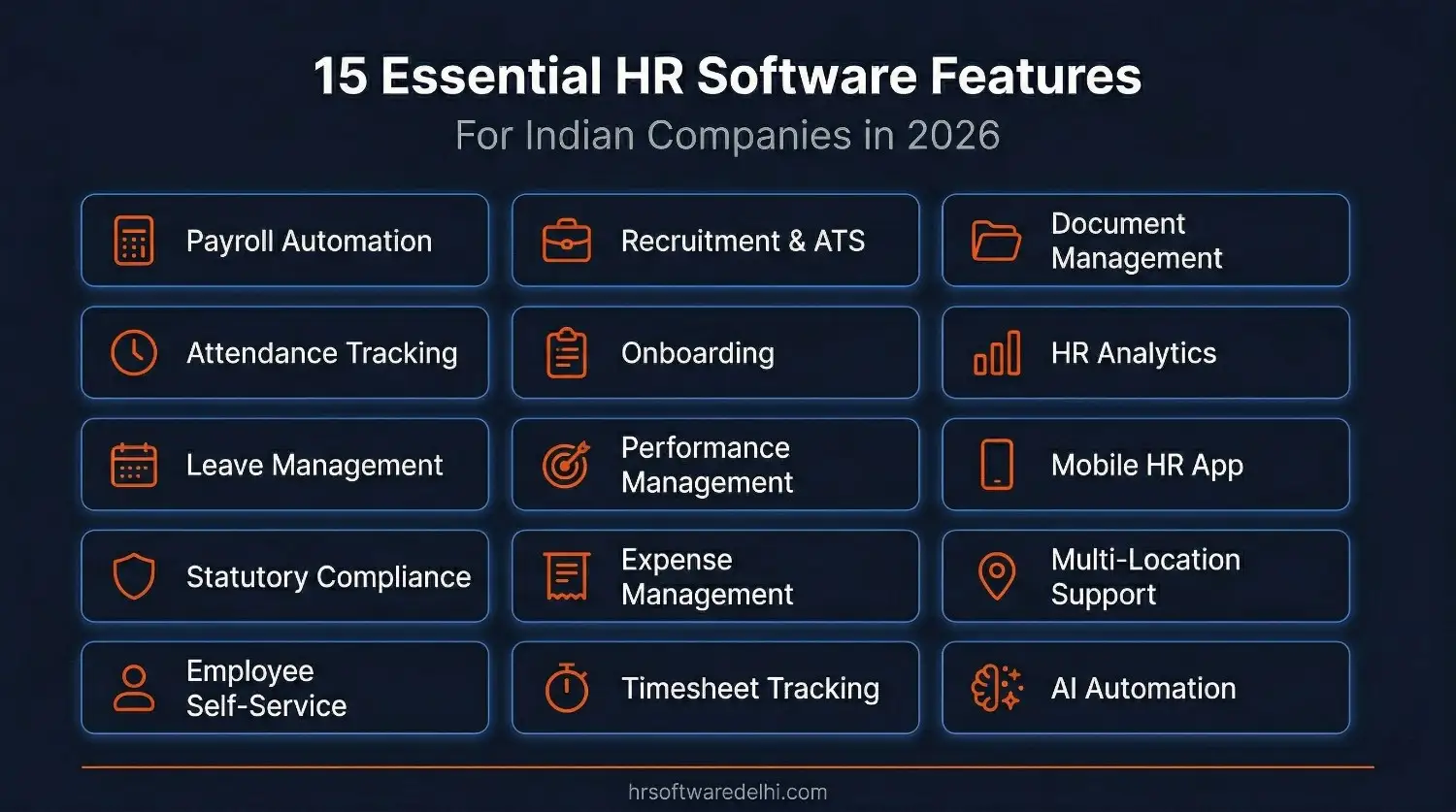
1. Payroll Automation
Payroll automation calculates salary from CTC to net pay, applies earnings and deductions, processes arrears and bonuses, and generates bank transfer files and payslips in one flow. For Indian payroll, the module handles EPF at 12 percent, ESI at 0.75 percent for employees and 3.25 percent for employers, TDS per the employee’s tax profile, and Professional Tax per state. Manual payroll errors do not stay small for long, especially when they affect statutory deposits and month-end closing. A strong payroll software module eliminates these risks entirely.
2. Attendance and Time Tracking
Robust attendance tracking integrates with physical biometric hardware like eSSL and Matrix devices, and also provides geo-fenced mobile punch-in with selfie capture for field teams. The module handles complex shift management, overtime calculation, and late marking rules on one screen. This becomes critical for Delhi NCR companies when staff work across office sites, customer locations, Noida branches, or Gurugram field routes. A dedicated attendance management system captures this data and syncs it directly to payroll.
3. Leave Management
An effective leave management module lets HR configure policies covering casual leave, sick leave, earned leave, comp-off, and maternity leave with proper rules for accrual, carry forward, encashment, and approval hierarchy. It connects with holiday calendars, attendance, and payroll so leave without pay and encashment are calculated correctly. Delhi employers benefit when leave workflows align with applicable Shops and Establishments requirements and internal approval timelines.
4. Statutory Compliance (EPF, ESI, TDS, PT)
Statutory compliance is one of the most important features of HR software because payroll accuracy is meaningless if filings are wrong. The module calculates EPF, ESI, TDS, and state-specific Professional Tax, generates ECR challans, supports Form 24Q for quarterly salary TDS reporting, and keeps records ready for Form 16 generation. The real value is not just calculation. It is staying current when wage ceilings, contribution rules, or government-notified thresholds change. Companies that process payroll without this automation risk penalties that compound monthly.
5. Employee Self-Service Portal
An employee self-service portal gives staff direct access to routine HR tasks instead of routing everything through the HR desk. Employees view payslips, apply for leave, update bank details, download Form 16, and submit investment declarations on their own. This single module typically reduces repetitive HR tickets by more than 60 percent and improves transparency across the organization.
6. Recruitment and Applicant Tracking
A recruitment module centralizes the hiring process by pushing job postings to multiple boards, parsing incoming resumes, scheduling interviews, and tracking the full candidate pipeline from application to offer acceptance. For growing Indian firms, this feature matters because hiring volume can increase faster than HR headcount, and email-based tracking breaks down quickly at scale.
7. Onboarding and Offboarding
Structured onboarding begins before day one with digital collection of Aadhaar, PAN, bank details, and signed documents. The system triggers welcome emails, department checklists, role-based task assignment, and asset allocation. On the exit side, the same module manages resignation workflows, clearance approvals, full and final settlement inputs, and automatic experience letter generation without manual gaps.
8. Performance Management
The performance management module digitizes employee evaluation through goal setting using OKRs or KPIs, 360-degree feedback, recurring review cycles, and bell curve normalization. Mature systems also link increment recommendations directly to payroll planning, so salary revisions do not depend on disconnected spreadsheets or manual data transfers between departments.
9. Expense and Reimbursement Management
Expense management lets employees submit claims with digital receipt uploads directly from their phones. The system enforces policy-based approval limits, flags duplicate claims, and pushes approved reimbursements into the next payroll cycle. For Indian businesses with travel-heavy teams, it also tracks GST input credits on employee travel expenses to assist finance with corporate tax filing.
10. Timesheet and Project Tracking
Timesheet tracking is essential for IT services, consulting, and project-based companies that need visibility into effort and billing. The module supports daily or weekly entries, project allocation, billable and non-billable hour tagging, and client-wise cost reports. Many technology and consulting firms across Delhi NCR work on multiple client accounts, making this one of the most practical HR software modules for services businesses.
11. Document Management
Secure document management creates a centralized employee-wise repository for Aadhaar, PAN, offer letters, appointment letters, appraisal records, and signed forms. It supports version control, expiry alerts for fixed-term contracts, and role-based access so managers only see what they are authorized to view. This is one of the simplest HR software functionality upgrades, but it removes a surprising amount of daily admin confusion.
12. HR Analytics and Dashboards
HR analytics transform raw employee data into visual insights on headcount trends, attrition analysis, payroll cost breakdowns, compliance status, and leave utilization patterns. The best dashboards help CXOs, HR heads, and finance leaders spot problems early and act before they become payroll corrections, retention crises, or staffing gaps. For mid-size companies, this is where HRMS features start delivering management value beyond process automation.
13. Mobile App Access
A dedicated mobile HR app brings core platform capabilities to the phones of your distributed workforce. Employees mark attendance, apply for leave, view payslips, and receive push notifications, while managers approve requests instantly from anywhere. This is essential for sales staff, site teams, retail workers, and managers who do not sit at a desk throughout the day.
14. Multi-Location and Multi-Entity Support
Multi-location capability allows one platform to manage employees across Delhi, Noida, Gurugram, and Faridabad without creating separate disconnected systems. The feature supports entity-wise payroll views, location-wise policies, and state-aware compliance logic for Professional Tax, LWF, and EPFO jurisdiction routing. NCR businesses need this because one legal entity may employ teams across different state borders and still need clean reporting by branch and cost center.
15. AI-Powered Automation (2026)
AI-powered automation introduces anomaly detection in attendance patterns, predictive attrition alerts for high-risk employees, smart salary benchmarking against industry standards, auto-generated HR letters, and chatbot support for routine employee queries. Used well, AI improves speed and consistency without replacing the judgment HR teams still need for sensitive decisions. This is the differentiator for modern HRMS platforms in 2026.
| Feature | What It Does | Priority | Best For |
|---|---|---|---|
| Payroll Automation | Automates salary calculation, deductions, payslips, and bank file processing | Essential | All companies |
| Attendance Tracking | Tracks presence, shifts, overtime, mobile attendance, and late rules | Essential | All companies |
| Leave Management | Handles leave rules, balances, approvals, and payroll impact | Essential | All companies |
| Statutory Compliance | Automates EPF, ESI, TDS, PT, and return filing | Essential | All Indian companies |
| Employee Self-Service | Lets staff view payslips, apply leave, and access documents | Essential | Companies with 20+ staff |
| Recruitment and ATS | Manages job postings, candidates, interviews, and offers | Important | Growing companies |
| Onboarding | Digitizes joining formalities, documents, and checklists | Important | Companies with 50+ staff |
| Performance Management | Tracks goals, reviews, feedback, and increment inputs | Important | Mid-size and large companies |
| Expense Management | Captures claims, approvals, receipts, and payroll-linked payouts | Important | Travel-heavy teams |
| Timesheet Tracking | Records work hours by project and billable status | Important | IT and consulting firms |
| Document Management | Stores employee files securely with expiry alerts | Important | All companies |
| HR Analytics | Shows trends in headcount, cost, attrition, and compliance | Important | Leadership teams |
| Mobile HR App | Enables HR actions and approvals on mobile | Important | Distributed workforce |
| Multi-Location Support | Handles cross-state compliance and entity reporting | Important | Multi-office companies |
| AI Automation | Predicts attrition, flags anomalies, and automates routine tasks | Nice to Have | Large enterprises |
HR Software Features by Company Size
Not every organization needs all 15 modules on day one. The right mix depends on headcount, process maturity, and compliance complexity. Small companies generally need the core six or seven transactional modules. Mid-size organizations typically require ten to twelve modules. Large enterprises need the full set to maintain operational control at scale.
| Feature | 10 to 50 Employees | 50 to 200 Employees | 200 to 500 Employees |
|---|---|---|---|
| Payroll Automation | Essential | Essential | Essential |
| Attendance Tracking | Essential | Essential | Essential |
| Leave Management | Essential | Essential | Essential |
| Statutory Compliance | Essential | Essential | Essential |
| Employee Self-Service | Essential | Essential | Essential |
| Document Management | Recommended | Essential | Essential |
| Recruitment and ATS | Recommended | Essential | Essential |
| Onboarding | Recommended | Essential | Essential |
| Performance Management | Optional | Recommended | Essential |
| Expense Management | Optional | Recommended | Essential |
| Mobile HR App | Recommended | Essential | Essential |
| Multi-Location Support | Skip | Recommended | Essential |
| HR Analytics | Skip | Recommended | Essential |
| Timesheet Tracking | Optional | Recommended | Recommended |
| AI Automation | Skip | Optional | Recommended |
Features Indian Companies Need That Global HRMS Platforms Miss
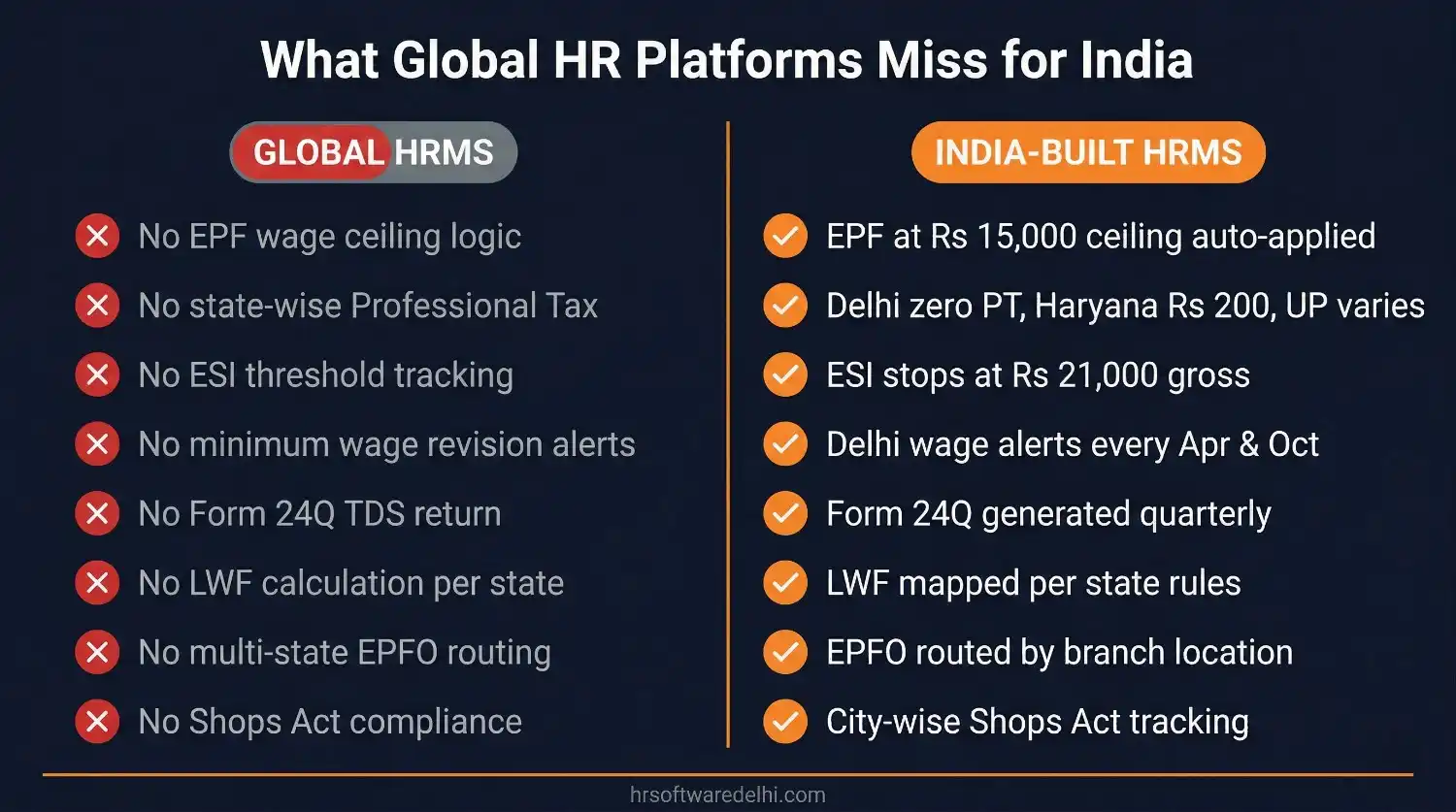
Many businesses purchase expensive global tools built for Western markets, only to discover those systems cannot handle Indian statutory complexity. Here are eight features of HR software that generic platforms consistently fail to deliver.
- EPF wage ceiling logic: Indian payroll requires correct EPF contribution handling including the Rs 15,000 wage ceiling for employer contribution calculation.
- State-wise Professional Tax: The system must apply different PT rules based on employee work location. Delhi charges zero PT, Haryana deducts Rs 200 per month for salaries above Rs 15,000, and Uttar Pradesh varies by designation.
- ESI threshold management: ESI eligibility depends on a Rs 21,000 gross wage ceiling, and the system must automatically stop or start ESI deductions when employees cross this threshold.
- Minimum wage revision alerts: Delhi Minimum Wages are revised every April and October by gazette notification. The platform should flag employees whose CTC falls below revised minimums before the next payroll run.
- Form 24Q salary TDS return: Quarterly salary TDS reporting requires structured data preparation that most global platforms do not support natively for the Indian income tax portal.
- LWF calculation per state: Labour Welfare Fund contributions differ by state. Delhi charges Rs 1 employee and Rs 2 employer per half year. Haryana and UP have different structures and deadlines.
- Multi-state EPFO jurisdiction routing: NCR companies with branches in Delhi, Haryana, and UP must route EPF challans to the correct regional EPFO office based on each branch location.
- Shops and Establishments Act compliance: Leave entitlements, working hours, spread-over limits, and register requirements vary by city and state. Global systems almost never handle this level of local granularity.
How to Evaluate HR Software Features Before Buying
Choosing the right HR software modules requires a structured evaluation, not a reliance on marketing brochures or a single demo call.
- List your must-have features by company size and industry. A 30-employee company may start with payroll, attendance, leave, self-service, compliance, and document management. A 250-employee services company will usually need recruitment, performance, expense, analytics, and multi-entity support as well.
- Demo each module separately. Do not buy based on a payroll and attendance walkthrough alone. Ask to see the actual modules you will use every week, including onboarding, employee self-service, reports, and approval workflows.
- Check compliance depth. Ask specific questions about EPF wage ceiling handling, ESI threshold logic, PT by state, TDS computation, and how the platform processes updates when government rules change.
- Test the mobile app with real scenarios. Have someone mark field attendance from a remote location, apply for leave, approve a request, and download a payslip from a phone. If that flow feels clumsy, employee adoption will remain poor.
- Verify integrations before signing. Confirm that the platform connects cleanly with your biometric hardware, accounting tools like Tally, bank payment process, and any existing recruitment or finance workflow.
Final Word
The right HR software features depend on your team size, operating model, compliance load, and how much manual work you want to eliminate. Some businesses need six or seven core modules at first, while others require the full set of HR software modules to support hiring, payroll, analytics, and workforce management at scale.
Choose a platform built for Indian payroll, policy, and statutory compliance from the ground up, not one adapted from a global template after the product was already designed. That is how the features of HR software become a business system your team will actually trust and use every month. If your Delhi NCR business is ready to move beyond Excel and manual processes, book a free demo to see these modules in action.
Frequently Asked Questions
What are the most important features of HR software?
The most important features are payroll automation, attendance tracking, leave management, statutory compliance, employee self-service, and document management. These are the HR software features that affect employees every month and create the largest admin burden when handled manually. Once these are stable, companies typically expand into recruitment, onboarding, analytics, and performance management.
What features should HR software have for Indian companies?
Indian companies need payroll with EPF, ESI, and TDS computation built in, attendance that supports biometric hardware and mobile punch-in, leave management aligned with state labour laws, and compliance automation that generates challans, Form 24Q, and Form 16. These HRMS features matter more than attractive dashboards because payroll and compliance mistakes carry real financial penalties.
Is payroll included in HR software?
In most modern platforms, yes. However, not all payroll modules offer the same depth. Some handle only basic salary calculation, while stronger systems cover CTC structuring, statutory deductions, arrears, bonuses, bank file generation, investment declarations, and compliance-ready outputs. Always confirm that full payroll processing with Indian statutory deductions is natively included before purchasing.
What is the difference between HRMS and HRIS features?
HRIS features focus on employee data storage, organizational charts, and basic reporting. HRMS features include everything HRIS offers plus transactional modules like payroll processing, attendance tracking, leave workflows, and performance evaluation. Most modern Indian platforms function as full HRMS solutions. You can read a detailed breakdown in our HRIS vs HRMS vs HCM comparison.
Do small businesses need all HR software features?
No. Small businesses should focus on features that eliminate the most manual work first: payroll, attendance, leave, compliance, self-service, and document storage. Advanced tools like performance appraisal matrices or AI analytics add unnecessary cost and complexity for a 20-person team. Choose a scalable platform that lets you add modules as your headcount grows.
What AI features should HR software have in 2026?
Practical AI features for 2026 include anomaly detection in attendance data to flag buddy punching, predictive attrition alerts for high-risk employees, smart salary benchmarking against industry data, auto-generated HR letters, and chatbots that handle routine policy queries. The value comes from reducing repetitive admin work, not from flashy labels or unproven capabilities.
How do I choose the right HR software features for my company?
Start by mapping the specific HR processes that cost your team the most time and cause the most errors. If manual payroll causes mistakes every month, prioritize payroll automation and compliance tracking. If managing distributed teams is chaotic, focus on mobile attendance and manager approvals. Always align your chosen HR software features with your immediate pain points to ensure a strong return on investment.
What HR software features help with compliance?
The most critical compliance features are payroll automation with statutory deduction logic, attendance-linked salary rules, leave policy enforcement, document management, and dedicated compliance modules for EPF, ESI, TDS, and Professional Tax. For companies operating across Delhi, Noida, and Gurugram, the system must also support location-aware compliance routing so each branch files to the correct statutory authority.
