
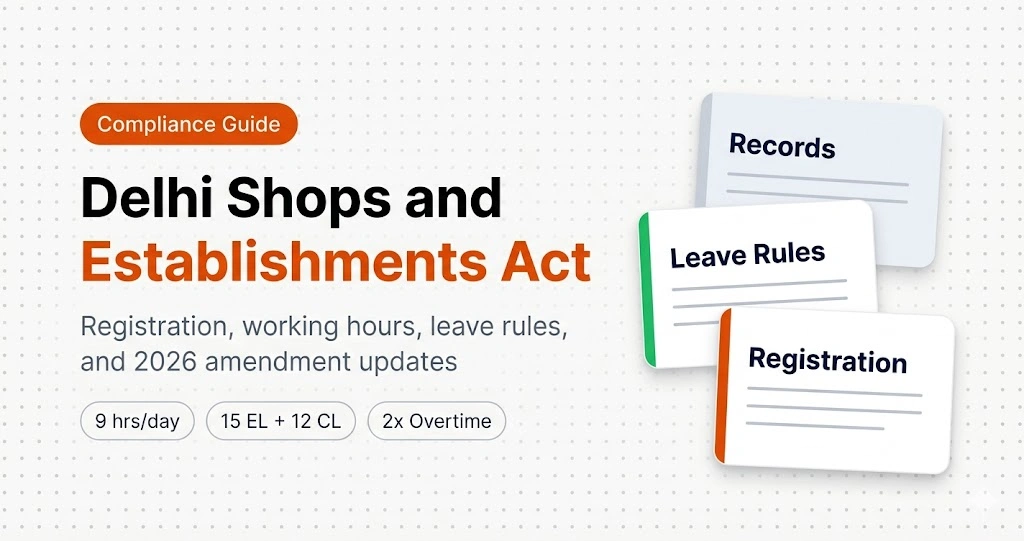
If you run a business in Delhi with even one employee, the Delhi Shops and Establishments Act applies to you. It governs how many hours your team can work, how much overtime costs, what leave they are entitled to, when they must have a weekly off, and what records you must maintain. Missing these rules is not a minor oversight. It creates labour department notices, employee disputes, and penalties that compound with every month of non-compliance. This guide breaks down the complete Act with the latest 2026 amendments so you know exactly what applies to your Delhi business.
- Who it applies to: Every shop and commercial establishment in Delhi with one or more employees must register within 30 days of starting operations.
- Working hours: 9 hours per day and 48 hours per week maximum. Overtime is paid at 2x the regular hourly rate.
- Leave entitlements: 15 days earned leave, 12 days casual and sick leave combined every year, plus paid public holidays.
- Maternity leave: 180 days (26 weeks) for first two children, aligned with the Maternity Benefit Act.
- Registration fees: Rs 50 to Rs 5,000 based on employee count, done online through labour.delhi.gov.in.
- 2026 update: The Delhi Shops and Establishments Amendment Bill 2026 proposes changes to working hours, night shifts for women, and overtime limits. Effective only after Gazette notification.
What Is the Delhi Shops and Establishments Act?
The Delhi Shops and Establishments Act, 1954 is the primary labour law that governs how commercial establishments in the National Capital Territory of Delhi operate. It was enacted in 1954 to protect employees working in shops, offices, and commercial establishments from excessive working hours, unfair wage practices, and unsafe conditions.
The Act covers every shop, office, hotel, restaurant, cinema, theatre, and commercial establishment operating in Delhi. It does not cover factories (which fall under the Factories Act 1948) or residential employment. If your Delhi business employs even one person other than a family member, you are legally required to register under this Act within 30 days of starting operations.
Who Must Register Under the Delhi Shops Act?
The Act applies to a wide range of establishments. If any of these describes your business, registration is mandatory:
- Shops: Any premises where goods are sold (retail or wholesale) including grocery stores, clothing outlets, electronics shops, and showrooms
- Commercial establishments: Offices, agencies, travel bureaus, software companies, consultancy firms, chartered accountant offices, and legal firms
- Restaurants and eateries: Hotels, restaurants, cafés, cloud kitchens, bars, and food delivery kitchens
- Entertainment venues: Cinemas, theatres, gaming zones, and event venues
- Service businesses: Salons, spas, gyms, coaching centres, and clinics
- Warehouses: Storage and distribution facilities that are not classified as factories
Who is exempt? Government offices, RBI, railways, and establishments covered under the Factories Act are outside the scope of this Act. Family-only businesses with no outside employees are also exempt.
How to Register Under the Delhi Shops Act
Registration is fully online through the Delhi Labour Department portal. The process takes 7 to 15 working days once documents are submitted.
- Visit the portal: Go to labour.delhi.gov.in and click on “Shops and Establishments” registration
- Create an account: Register with your email, PAN, and mobile number
- Fill Form A: Submit establishment name, address, nature of business, employer details, date of commencement, and total number of employees
- Upload documents: Identity proof, address proof of establishment, PAN of business entity, list of directors/partners (if applicable), and photo of the establishment
- Pay the fee: Fee is calculated based on number of employees (Rs 50 to Rs 5,000)
- Receive certificate: Registration certificate is issued digitally and must be displayed prominently at the establishment
| Number of Employees | Registration Fee |
|---|---|
| 0 to 5 | Rs 50 |
| 6 to 10 | Rs 200 |
| 11 to 20 | Rs 500 |
| 21 to 50 | Rs 1,000 |
| 51 to 100 | Rs 2,500 |
| Above 100 | Rs 5,000 |
Renewal: The registration certificate must be renewed periodically as prescribed by the Labour Department. Any change in employer details, address, or nature of business must be intimated within 15 days of the change.
Working Hours Under the Delhi Shops Act
The working hour rules under the Act protect employees from overwork while giving employers clear limits to design shift structures.
Daily and Weekly Limits
- Daily limit: Maximum 9 hours of work per day
- Weekly limit: Maximum 48 hours of work per week
- Spread-over: The total presence at the establishment (including breaks) should not exceed 12 hours in a day
- Rest interval: A 30-minute break is mandatory after 5 hours of continuous work
Overtime Rules
Overtime beyond 9 hours per day or 48 hours per week is allowed in specific cases like stock taking, accounts, or urgent business needs. However, strict limits apply.
- Maximum overtime: 54 hours per week (including 48 regular hours), and 150 hours per year in total
- Overtime rate: Twice (2x) the regular hourly wage for all overtime hours
- Documentation: Overtime hours must be recorded in the muster roll and wage register
- Consent: Overtime should be voluntary. Forcing overtime without compensation is a violation.
The overtime calculation is straightforward. If an employee earns Rs 30,000 per month (Rs 115 per hour based on 26 working days), one hour of overtime costs Rs 230.
Weekly Off and Holidays
The Act guarantees every employee at least one full day off per week, along with paid public holidays.
- Weekly off: Every employee is entitled to one full day of paid rest per week. Most establishments observe Sunday as the weekly off, but any day can be designated.
- Closed day: Each establishment must declare one closed day per week and intimate it to the Labour Department. The closed day cannot be changed more than once in three months.
- Public holidays: Republic Day (26 January), Independence Day (15 August), and Mahatma Gandhi Jayanti (2 October) are mandatory paid holidays. Most establishments offer 10 to 14 public holidays per year.
- Festival holidays: Major festivals like Diwali, Holi, Eid, Christmas, and Dussehra are commonly declared as paid holidays based on the employer’s annual holiday list.
See the latest Delhi holiday calendar for the complete list of declared public holidays.
Leave Entitlements Under the Delhi Shops Act
The Act mandates three categories of paid leave for every employee in a Delhi establishment. These are minimum entitlements. Employers can offer more, but not less.
Earned Leave (Privilege Leave)
- Entitlement: 15 days per year after completing 12 months of continuous employment
- Accrual: 5 days for every 4 months of continuous employment (accrues proportionately)
- Carry forward: Unused earned leave can typically be carried forward to the next year (subject to company policy, usually capped at 30 to 45 days)
- Encashment: Earned leave balance can be encashed at the time of exit or retirement
Casual Leave and Sick Leave
- Combined entitlement: 12 days per year (typically split as 7 days casual + 5 days sick, or variations based on company policy)
- Accrual: 1 day per month of continuous employment
- Carry forward: Typically not carried forward. Unused CL and SL lapse at the end of the calendar year.
- Documentation: Sick leave beyond 3 days may require a medical certificate
Maternity Leave
- Entitlement: 180 days (26 weeks) of paid maternity leave for the first two children
- Third child onwards: 84 days (12 weeks) of paid leave
- Adopting and commissioning mothers: 84 days (12 weeks) of paid leave
- Eligibility: Female employees who have worked for at least 80 days in the 12 months preceding the expected date of delivery
- Governing Act: Maternity Benefit Act 1961 (applies alongside Delhi Shops Act)
Leave Pay Calculation
Leave pay is calculated at the daily average of wages from the preceding three months, excluding overtime earnings but including dearness allowance. This means the leave payment should match the employee’s regular salary for the same number of days.
Summary of Leave Entitlements
| Leave Type | Entitlement (Per Year) | Accrual Basis | Carry Forward |
|---|---|---|---|
| Earned Leave (EL) | 15 days | 5 days per 4 months | Yes, usually capped |
| Casual + Sick Leave (CL + SL) | 12 days combined | 1 day per month | No, lapses yearly |
| Maternity Leave | 180 days (first 2 children) | After 80 days of service | Not applicable |
| Public Holidays | 10 to 14 days | Annual holiday list | Not applicable |
| Weekly Off | 52 days (1 per week) | Continuous | Not applicable |
Records and Registers to Maintain
The Delhi Labour Department requires every registered establishment to maintain specific records that can be inspected at any time. Missing records trigger notices and penalties.
- Register of employment: Names, roles, joining dates, and current status of all employees
- Register of wages: Monthly wage records with breakup of earnings, deductions, and net pay
- Muster roll: Daily attendance with in-time, out-time, and overtime hours
- Register of leave: Leave balance and utilization record for each employee
- Wage slips: Issued monthly to every employee. Must show salary structure clearly.
- Notice of closed day: Declared closed day must be displayed prominently
- Abstract of the Act: A copy of the Act or its summary should be displayed in the establishment
Most of these records are automatically maintained by modern HRMS platforms, which is why digital record-keeping through payroll software has become standard for Delhi businesses.
Employment of Women
The Act specifically addresses employment conditions for women to ensure safety and equal opportunity.
- Equal pay: Equal wages for equal work regardless of gender (also covered under Equal Remuneration Act)
- Night shift restrictions: Under the current Act, women cannot be employed between 9 PM and 7 AM in most establishments. The 2026 Amendment Bill proposes relaxations with mandatory safety provisions.
- Safety provisions: Employers must ensure safe transport, adequate security, and grievance redressal for women employees
- POSH Act compliance: Every establishment with 10 or more employees must have an Internal Complaints Committee (ICC) under the POSH Act 2013
Employment of Young Persons
- Children under 14: Prohibited from employment in any establishment (aligned with the Child Labour Act)
- Young persons (14 to 17 years): May be employed subject to restrictions on working hours (maximum 6 hours per day)
- No night work: Young persons cannot be employed between 7 PM and 8 AM
- Rest intervals: At least a 30-minute break after 3 hours of continuous work
Delhi Shops and Establishments (Amendment) Bill 2026
On 9 January 2026, the Delhi Government issued the Delhi Shops and Establishments (Amendment) Bill 2026, proposing significant updates to the 1954 Act. The Bill’s provisions will come into force only when notified by the Government of NCT of Delhi in the Official Gazette.
Key proposed changes:
- Working hours flexibility: Revised provisions on daily and weekly working hour limits to accommodate modern service industries and 24-hour operations
- Overtime limits: Updated overtime ceilings aligned with contemporary business practices
- Night shift for women: Expanded provisions allowing women to work night shifts in more sectors, subject to mandatory safety measures (transport, security, consent, facilities)
- Employer safety obligations: Enhanced requirements for workplace safety, grievance redressal, and employee welfare
- Digital compliance: Stronger emphasis on online registration, digital records, and e-filing of returns
What employers should do now: Monitor the Delhi Gazette for the effective date notification. Begin reviewing existing policies on working hours, overtime, and women’s night shift employment. Update HR systems and employee handbooks once the amendment is notified.
Penalties for Non-Compliance
Violations of the Delhi Shops and Establishments Act attract specific penalties. Repeat offences increase the penalty amount and can lead to prosecution.
| Violation | Penalty (Approximate) |
|---|---|
| Operating without registration | Rs 25 to Rs 250 initial penalty, plus daily fine for continued default |
| Exceeding working hour limits | Fine up to Rs 1,000 plus compensation to employees |
| Not paying overtime at 2x rate | Penalty plus recovery of due overtime wages with interest |
| Not maintaining registers | Fine up to Rs 500 per missing register |
| Repeat violations | Fines up to Rs 2,000 and possible prosecution |
| Obstructing labour inspector | Fine up to Rs 1,000 and imprisonment in serious cases |
Beyond the direct fines, non-compliance also triggers employee disputes, loss of workplace credibility, and scrutiny during company audits or due diligence processes.
Common Compliance Mistakes Delhi Employers Make
- Delayed registration: Operating for months without registering while “planning to do it soon.” The 30-day clock starts from the day your first employee joins.
- Wrong overtime calculation: Paying overtime at 1.5x or flat rates instead of the mandatory 2x. The Act requires twice the normal hourly rate, not time-and-a-half.
- Mixing casual and earned leave policies: Issuing a blanket “annual leave” policy without distinguishing earned (15), casual + sick (12), and public holidays. Employees can legally claim the statutory minimums.
- Not displaying the registration certificate: The certificate must be prominently displayed at the establishment. A certificate in a drawer does not satisfy the requirement.
- Incomplete muster rolls: Relying on biometric data without maintaining the statutory muster roll format. Inspectors specifically check for the Act-prescribed register.
- Ignoring weekly off documentation: Not declaring the weekly closed day to the Labour Department or changing it frequently without notice.
- Missing maternity benefits: Some employers still provide only 12 weeks of maternity leave, following older rules. The correct entitlement is 180 days (26 weeks) for the first two children under the current Maternity Benefit Act.
- No POSH committee: Establishments with 10+ employees must have an Internal Complaints Committee. Missing this is a separate violation under the POSH Act 2013.
How HR Software Helps with Delhi Shops Act Compliance
Manual record-keeping works for 5-person businesses. Beyond 20 employees, maintaining compliant registers, accurate attendance, overtime calculations, and leave entitlements becomes a full-time job. Modern HR software automates most of this:
- Digital muster roll with biometric and mobile attendance
- Auto-calculation of overtime at 2x rate with weekly and annual caps
- Leave accrual based on 5 days per 4 months and 1 day per month rules
- Maternity leave tracking with 180-day entitlement for first two children
- Auto-generation of wage registers and payslips meeting Act requirements
- Holiday calendar with Delhi-specific public holidays
- Alerts for weekly off declarations and registration renewals
For multi-state companies operating in Delhi plus Haryana and UP offices, the software must also apply state-specific rules correctly. Delhi has zero Professional Tax. Haryana charges Rs 200. UP has slab-based PT. The right HR software in Delhi applies these state rules automatically. A compliant system handles all three in one payroll run.
Final Word
The Delhi Shops and Establishments Act is not a complex piece of legislation. It sets clear rules on hours, overtime, leave, and records. The only complexity comes from keeping these compliant as your team grows and rules update. The 2026 Amendment Bill will bring further changes once notified, especially around women’s night shift employment and overtime limits.
For any Delhi business with 10+ employees, the safest approach is to digitize compliance from the start. Manual registers and Excel-based tracking break down as you scale. If you want to see how automated compliance handles Delhi Shops Act requirements end-to-end, book a free demo.
Alongside this Act, the four new labour codes 2026 now apply to Delhi establishments and change several of these rules.
Frequently Asked Questions
Is the Delhi Shops and Establishments Act registration mandatory?
Yes. Every shop, commercial establishment, hotel, restaurant, or service business in Delhi with at least one employee must register within 30 days of starting operations. Running without registration attracts penalties and can halt your business operations.
What is the registration fee for Delhi Shops Act?
The fee ranges from Rs 50 to Rs 5,000 based on the number of employees. Businesses with 0-5 employees pay Rs 50. Those with 100+ employees pay Rs 5,000. Registration is done online through labour.delhi.gov.in.
What are the working hours under the Delhi Shops Act?
Maximum 9 hours per day and 48 hours per week. Employees are entitled to a 30-minute break after 5 hours of continuous work. Total spread-over (presence at workplace including breaks) cannot exceed 12 hours in a day.
What is the overtime rate under the Delhi Shops Act?
Overtime is paid at twice (2x) the regular hourly rate. Maximum overtime allowed is 54 hours per week and 150 hours per year. Forcing overtime without paying the 2x rate is a violation of the Act.
How many leaves are employees entitled to under the Delhi Shops Act?
Employees are entitled to 15 days of earned leave per year, 12 days of combined casual and sick leave, plus public holidays (typically 10 to 14 days). Female employees get 180 days of maternity leave for the first two children.
How many public holidays are mandatory in Delhi?
Three national holidays are mandatory and paid: Republic Day (26 January), Independence Day (15 August), and Mahatma Gandhi Jayanti (2 October). Most Delhi employers also declare major festivals like Diwali, Holi, Eid, and Dussehra as paid holidays.
Does the Delhi Shops Act apply to startups and home offices?
Yes, if the startup has any paid employees. It applies regardless of revenue size or office type. A home-based business with one employee still needs to register. Only family-only businesses with no outside employees are exempt.
What records must be maintained under the Delhi Shops Act?
Register of employment, register of wages, muster roll (daily attendance), register of leave, wage slips, notice of closed day, and a copy of the Act. All records must be available for labour inspectors on demand and retained for the prescribed period.
