
Indian HR teams set KRAs for over 80 percent of their workforce, yet half of those KRAs go unmeasured by year-end. The reason is rarely intent. It is structure. What is KRA in HR? Key Result Area is the specific outcome an employee owns, the measurable contribution that decides their performance rating, increment, and promotion. This guide covers the full meaning, the SMART framework, the 8-step setup process, 25+ role-wise examples, and a free template you can adapt today.
- KRA full form: Key Result Area. The major area of responsibility where an employee is expected to deliver results, measured against pre-defined targets.
- Difference from KPI: KRA is the area (what to deliver). KPI is the metric (how to measure). KRA “Customer Retention”. KPI “Retain 92 percent of accounts quarterly”.
- Setup process: Use the SMART framework (Specific, Measurable, Achievable, Relevant, Time-bound) and follow an 8-step process from organisational mapping to documentation.
- Examples by role: Sales head owns Revenue + Pipeline + Retention. HR manager owns Hiring TAT + Attrition + Compliance. CEO owns Growth + EBITDA + Strategic Partnerships.
- Review frequency: Quarterly check-ins are standard. Annual review locks the rating. Strong performance management software keeps both employee and manager aligned.
- Common mistake: Confusing KRA with job description. JD describes the role. KRA defines the measurable outcomes from the role.
What Is KRA in HR?
A Key Result Area is the specific outcome an employee is accountable for delivering during a defined period, usually a quarter or a year. It is the contribution by which the organisation measures whether the role is succeeding or failing. KRAs sit between the high-level company objective and the day-to-day task list, translating strategy into measurable individual ownership.
Unlike a job description that describes the role broadly, a KRA narrows the role to 4-7 specific result buckets. Each bucket has measurable outcomes, weightage, and a review cycle. When all employees deliver against their KRAs, the company hits its annual plan. When KRAs are misaligned or vague, performance reviews become subjective conversations rather than data-driven decisions.
KRA Full Form Explained
KRA stands for Key Result Area. The phrase was coined by management consultant Peter Drucker in the 1950s as part of Management by Objectives (MBO). Indian companies adopted the framework heavily in the 1990s and 2000s as performance reviews shifted from subjective annual ratings to outcome-based measurement.
The “Key” implies prioritisation. An employee may do twenty things in a week, but only 4 to 7 truly drive the role’s value. The “Result Area” implies outcome ownership, not effort. Showing up to meetings is effort. Closing the customer at the end of the quarter is a result.
KRA vs KPI vs OKR: What Is the Difference?
These three frameworks are often used interchangeably, which is the single biggest cause of confusion in performance reviews. Each one serves a different purpose.
| Framework | What it defines | Example | Best fit |
|---|---|---|---|
| KRA (Key Result Area) | The area of accountability | “Customer Retention” | Indian HR performance management. Annual reviews. Increment cycles. |
| KPI (Key Performance Indicator) | The metric used to measure the KRA | “Retain 92 percent of accounts each quarter” | Day-to-day operational dashboards |
| OKR (Objective and Key Results) | An ambitious objective with measurable key results | “Become the most-loved HR platform in Delhi NCR. KR1: 4.7 G2 rating. KR2: 50 case studies.” | Tech companies, startups, ambitious quarterly goals |
For Indian HR teams running annual appraisals, KRA + KPI is the workhorse combination. OKRs work better as a strategic overlay for senior leadership and product teams. Our deeper guide on KRA and KPI differences walks through how to use them together without overlap.
Why KRAs Matter for Indian Businesses
The shift from informal ratings to KRA-based performance management changed how Indian companies promote, increment, and retain talent. Five reasons KRAs matter more than ever in 2026.
- Subjectivity drops. Without KRAs, “good performer” is whoever the manager remembers favourably. With KRAs, the rating ties to numbers everyone agreed at the start of the year.
- Promotions become defendable. When two employees deserve one promotion, the KRA achievement percentage settles the discussion in 5 minutes, not 5 emails.
- Increments become predictable. Indian salary planning is tight. KRA-based increments protect HR from arbitrary “match the offer” pressure.
- Attrition risks surface early. Employees with consistently low KRA achievement either lack clarity, lack support, or lack fit. KRAs make the issue visible by the second quarter.
- Multi-state Indian teams stay aligned. Delhi office, Bengaluru engineering, Mumbai sales, all working from the same KRA template flowing into the same performance management software.
SMART Framework for Setting KRAs
SMART is the test every KRA must pass before it goes into the appraisal sheet. The acronym was popularised by George Doran in 1981 and remains the global standard. A KRA that is not SMART is a wish.
| SMART | Test | Bad KRA | SMART KRA |
|---|---|---|---|
| Specific | Is it precise enough that two people would interpret it the same way? | “Improve customer experience” | “Reduce customer support tickets by 25 percent in Delhi NCR accounts” |
| Measurable | Can you put a number on it? | “Build better team culture” | “Increase employee engagement score from 6.8 to 7.5 on quarterly survey” |
| Achievable | Is it realistic given resources and constraints? | “100x revenue this year” | “Grow revenue from Rs 2.4 cr to Rs 3.6 cr in FY 2026-27” |
| Relevant | Does it tie to a business priority? | “Train on a new tool” | “Reduce monthly payroll processing time by 40 percent through HRMS adoption” |
| Time-bound | Is there a deadline? | “Hire faster” | “Reduce time-to-hire from 45 days to 28 days by Q3” |
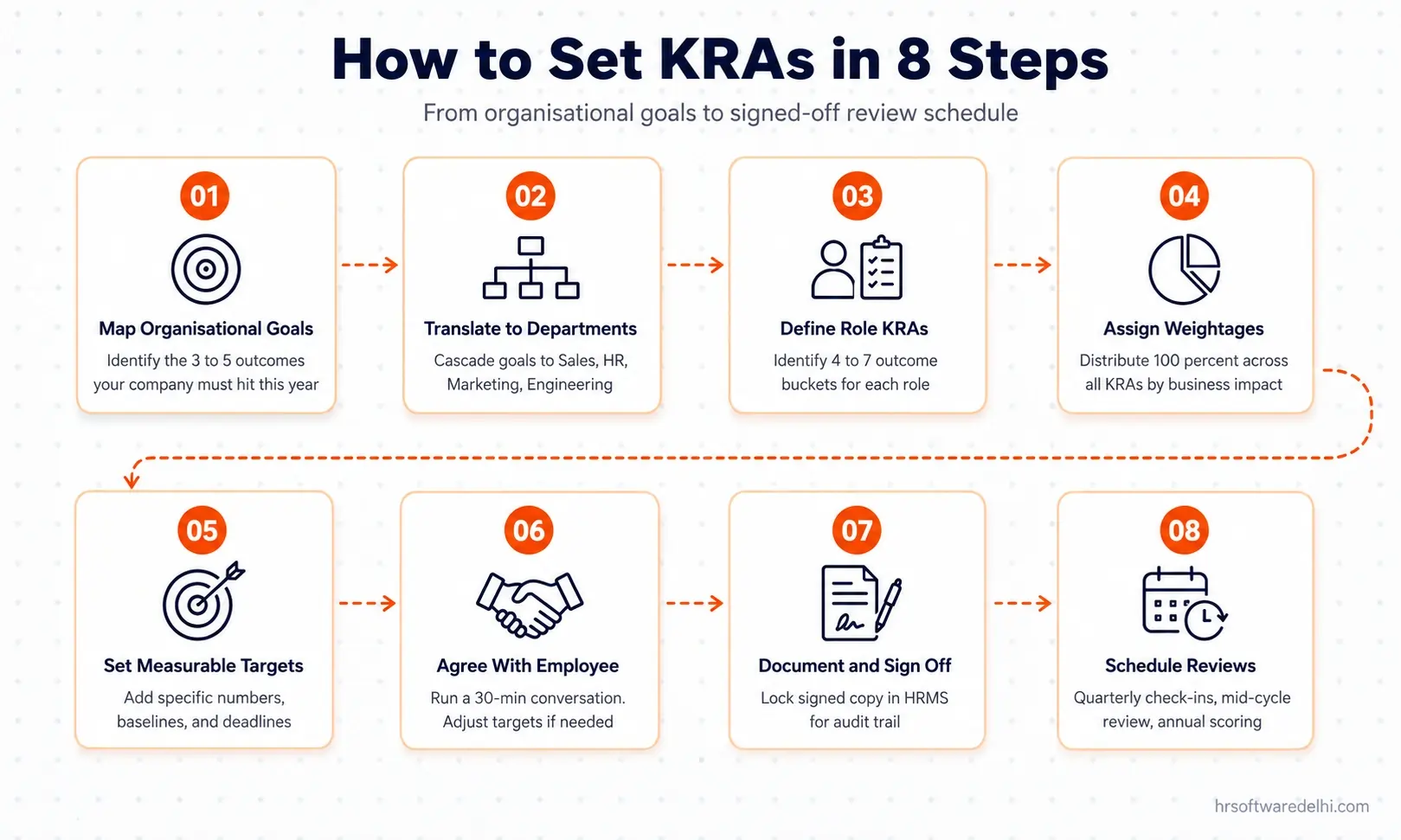
How to Set KRAs: 8-Step Process
The process below works for any role at any company size. The steps build on each other. Skipping step 1 makes step 7 impossible.
Step 1: Map Organisational Goals
Start with the business plan. What 3 to 5 outcomes must the company hit this year? Revenue growth, market expansion, profitability, customer base expansion, product launches. KRAs at every level must trace back to one of these.
Step 2: Translate Goals to Department Outcomes
If company goal is “grow revenue 40 percent”, what does each department contribute? Sales drives top-line. Marketing drives lead volume. Customer Success drives retention. Engineering drives product roadmap.
Step 3: Define Role-Level KRAs
Within each department, what specific outcomes does each role own? A Sales Manager in Delhi NCR may own Revenue, Pipeline Hygiene, and Team Productivity. A Sales Executive may own only Revenue and Activity Metrics.
Step 4: Assign Weightages
Not every KRA carries equal weight. Allocate percentages summing to 100. A Sales Manager’s typical split: Revenue 50 percent, Pipeline 25 percent, Team Productivity 15 percent, Compliance 10 percent.
Step 5: Set Measurable Targets
Each KRA needs a specific number. Not “high revenue”, but “Rs 2.4 crore quarterly”. Not “low attrition”, but “below 12 percent annualised”.
Step 6: Agree With the Employee
KRAs imposed without buy-in fail by month two. Run a 30-minute conversation. Walk through each KRA. Confirm the employee believes the target is achievable. Adjust if not.
Step 7: Document and Sign Off
Print or digitally lock the KRA sheet. Both employee and manager sign. Store in HRMS. The signed copy ends every dispute about “what was the target”.
Step 8: Schedule Reviews
Quarterly check-ins to track progress. Half-year mid-cycle review. Annual final review. Adjust mid-cycle only if business priorities genuinely change. Never to make targets easier.
KRA Examples by Department
Generic SMART theory is hard to apply without examples. Here are real KRAs by department, used by mid-market Indian companies.
Sales Department KRAs
- Achieve quarterly revenue target of Rs 2.4 crore
- Maintain pipeline coverage of 4x quarterly target
- Close 18 new accounts in Delhi NCR by Q4
- Retain 92 percent of existing accounts year-on-year
- Achieve average deal size of Rs 4.2 lakh
HR Department KRAs
- Reduce time-to-hire from 45 days to 28 days
- Maintain employee attrition below 14 percent annualised
- Increase engagement score from 6.8 to 7.5
- Achieve 100 percent statutory compliance with no late filings
- Complete payroll processing by 28th of every month
Marketing Department KRAs
- Generate 1,200 marketing-qualified leads per quarter
- Reduce cost per lead from Rs 480 to Rs 320
- Drive 35 percent of pipeline from inbound channels
- Publish 12 thought-leadership content pieces per quarter
- Grow LinkedIn audience from 5,000 to 12,000 followers
Customer Success KRAs
- Maintain Net Revenue Retention above 110 percent
- Reduce churn rate below 6 percent annualised
- Achieve customer satisfaction score above 4.5 of 5
- Onboard 95 percent of new customers within 14 days
- Drive 25 percent revenue from upsell and cross-sell
Engineering KRAs
- Ship 5 product features per quarter as per roadmap
- Maintain system uptime above 99.9 percent
- Reduce average bug resolution time from 4 days to 2 days
- Improve page-load speed to under 2 seconds
- Maintain code review coverage above 90 percent
Finance Department KRAs
- Close monthly books by 5th working day
- Maintain DSO (Days Sales Outstanding) below 45 days
- Achieve audit compliance with zero major observations
- Reduce payroll error rate below 0.5 percent
- File all GST, TDS, and statutory returns within deadlines
KRA Examples by Designation
The same department has different KRAs at different levels. A CEO and a Sales Executive both work in the company, but the outcomes they own are radically different.
| Designation | Top 3 KRAs | Sample Weightage |
|---|---|---|
| CEO | Revenue Growth, EBITDA Margin, Strategic Partnerships | 40-30-30 |
| CHRO | Attrition, Hiring Targets, Compliance | 40-35-25 |
| Head of Sales | Revenue, Pipeline Health, Team Productivity | 50-25-25 |
| HR Manager | Hiring TAT, Engagement Score, Statutory Compliance | 40-30-30 |
| Sales Executive | Quarterly Revenue, Activity Metrics, Pipeline Quality | 60-25-15 |
| Software Engineer | Feature Delivery, Code Quality, Bug Reduction | 50-30-20 |
| Customer Success Manager | Retention, Upsell Revenue, NPS | 45-30-25 |
| Marketing Manager | MQL Volume, Pipeline Contribution, Brand Metrics | 40-40-20 |
| Finance Manager | Books Closure Time, Compliance Filings, Cost Control | 40-35-25 |
| Operations Manager | SLA Adherence, Cost per Unit, Team Output | 45-30-25 |
Industry-Specific KRA Examples
Indian industries have unique KRA priorities. A manufacturing supervisor measures yield, an IT delivery manager measures sprint velocity, and a hospital operations head measures bed turnover.
Manufacturing
- Maintain Overall Equipment Effectiveness (OEE) above 78 percent
- Reduce defect rate below 0.5 percent
- Achieve on-time delivery above 95 percent
- Reduce raw material wastage below 3 percent
- Maintain workforce safety with zero lost-time incidents
IT Services
- Deliver projects on time at 95 percent rate
- Maintain client satisfaction score above 4.5
- Achieve billable utilisation of 85 percent
- Improve sprint velocity by 20 percent year-on-year
- Maintain employee retention above 88 percent
Healthcare
- Maintain bed occupancy rate at 80-85 percent
- Achieve average length of stay reduction by 8 percent
- Maintain readmission rate below 4 percent
- Achieve patient satisfaction above 4.7 of 5
- Maintain compliance with NABH and quality standards
Retail
- Achieve same-store sales growth of 12 percent
- Maintain inventory turnover ratio above 6x
- Reduce shrinkage below 1.2 percent
- Improve conversion rate from footfall by 18 percent
- Maintain employee productivity per square foot above target
BPO and KPO
- Maintain Average Handle Time within SLA
- Achieve customer satisfaction (CSAT) above 4.6
- Maintain attrition below 30 percent annualised
- Achieve First Call Resolution above 80 percent
- Maintain quality scores above 92 percent on monitored calls
KRA vs Job Description: What Is the Difference?
This confusion blocks half the KRA implementations we see in Indian SMBs. The two are different tools with different purposes.
| Aspect | Job Description (JD) | KRA |
|---|---|---|
| Purpose | Defines what the role does | Defines what the role must achieve |
| Used for | Hiring, onboarding, compliance | Performance review, increment, promotion |
| Format | Bullet list of responsibilities | 4 to 7 outcome statements with targets and weightage |
| Frequency of update | When role changes (annually or less) | Every quarter or year |
| Measurement | Pass/fail (does the person do the listed tasks?) | Quantitative score against targets |
| Example | “Process payroll for all employees” | “Process payroll on time for 98 percent of months with under 0.5 percent error rate” |
KRA Calculation: How to Score Performance
At the end of the cycle, you need a single percentage number that captures overall performance. The formula handles weighted KRAs cleanly.
Overall KRA Score = Sum of (Achievement % × Weightage) for each KRA
Worked example for a Sales Manager:
| KRA | Target | Achieved | Achievement % | Weightage | Weighted Score |
|---|---|---|---|---|---|
| Revenue | Rs 2.4 cr | Rs 2.6 cr | 108% | 50% | 54 |
| Pipeline | 4x | 3.6x | 90% | 25% | 22.5 |
| Team Productivity | 92% productive | 88% | 96% | 15% | 14.4 |
| Compliance | Zero misses | 1 miss | 80% | 10% | 8 |
| Overall KRA Score | 98.9% | ||||
This score then maps to the appraisal rating: 95-110 percent typically means “Exceeds Expectations”, 80-94 percent means “Meets Expectations”, below 80 percent triggers a performance improvement plan.
Common Mistakes Companies Make Setting KRAs
| Mistake | Better Approach |
|---|---|
| Confusing JD with KRA | JD lists tasks. KRA defines outcomes. Both should exist, separately, in the HRMS. |
| Setting too many KRAs (10+) | Limit to 4-7. More than 7 means none are truly “Key”. |
| Vague targets (“improve quality”) | Always include a number, a comparison baseline, and a deadline. |
| Same KRAs for entire team regardless of role | Customise per role. A team lead’s KRAs differ from a team member’s. |
| Weightages all equal (25 percent each) | Weight by business impact. Revenue KRAs typically weight 40-60 percent for sales roles. |
| Set in January, ignored until December | Review quarterly. Mid-cycle adjustments only if business priority genuinely changes. |
| KRAs not tied to organisational goals | Every KRA must trace to a company-level outcome. Otherwise the role exists in isolation. |
| No buy-in from employee | 30-min agreement conversation before signing. Imposed KRAs fail by month two. |
| Stored in scattered Excel sheets | Lock in HRMS. Both manager and employee have one source of truth. |
KRA Review Cycles for Indian Companies
Indian appraisal cycles typically run April to March, aligned to the financial year. Within that cycle, the standard pattern is:
- Cycle Start (April): KRA setting, weightage agreement, signed copy stored
- Q1 Review (June-July): Brief check-in. No formal rating. Adjust targets only for major business changes.
- Mid-Cycle Review (September-October): Half-year formal review. Calibrate scores. Trigger PIPs if needed.
- Q3 Review (December-January): Pre-final check. Identify high performers for promotions.
- Annual Review (February-March): Final scoring, increment decisions, promotion calibration. Communicated by 31 March for 1 April salary revisions.
Most Indian companies layer 360-degree feedback on top of the KRA score. The KRA gives the objective number. 360 feedback adds qualitative insight on collaboration, leadership, and behaviour.
Free KRA Template Format
Use this structure as the base for any role. Adapt the KRAs and targets to fit your context.
| Field | Example Value |
|---|---|
| Employee Name | Rohit Sharma |
| Employee ID | EMP001 |
| Designation | Sales Manager |
| Department | Sales |
| Reporting Manager | Priya Mehta (Head of Sales) |
| Cycle | April 2026 to March 2027 |
| KRA 1: Title | Quarterly Revenue Achievement |
| KRA 1: Target | Rs 2.4 crore per quarter |
| KRA 1: Weightage | 50 percent |
| KRA 2: Title | Pipeline Health |
| KRA 2: Target | Maintain 4x pipeline coverage |
| KRA 2: Weightage | 25 percent |
| Manager Sign-off | (Signature + Date) |
| Employee Sign-off | (Signature + Date) |
Tools to Track KRAs in 2026
Excel works for under 50 employees. Above that, scattered sheets cause exactly the chaos KRAs were meant to solve. Modern HRMS platforms handle KRA setup, mid-cycle scoring, manager reviews, employee self-assessment, and final calibration in one place.
Look for these features when evaluating performance management tools for your Indian business:
- Role-based KRA templates (assign once per role, applied to all in that role)
- Real-time KRA score dashboards for managers
- Employee self-assessment workflow
- Calibration tools to normalise scores across teams
- Bell curve analysis for promotion decisions
- Automatic increment calculation linked to payroll
- Mobile app for on-the-go check-ins
- Audit trail of every score change with timestamps
Connecting KRA outcomes directly to payroll closes the loop. High performers get auto-calculated increments, payroll runs without manual intervention, and HR teams stop chasing managers for sheets in March. For broader feature evaluation, see our overview of essential HR software features for Indian businesses.
Final Word
KRAs are simple in concept and brutally hard in execution. Most Indian companies set them in April and remember them only in March. The companies that actually drive business outcomes through KRAs do three things differently. They limit KRAs to 4-7 per role. They tie every KRA to an organisational goal. And they review quarterly, not annually.
If your team still tracks KRAs in scattered Excel files, the right performance management software closes the gap. Every KRA, every review, every score lives in one system. Increments flow to payroll. PIPs trigger automatically when scores slip. Annual reviews stop being painful conversations and start being data-driven decisions.
Frequently Asked Questions
What is the full form of KRA?
KRA stands for Key Result Area. It defines the major area of responsibility where an employee is expected to deliver measurable outcomes. The framework was created by management consultant Peter Drucker in the 1950s as part of Management by Objectives.
What is the difference between KRA and KPI?
KRA defines the area of accountability (“Customer Retention”). KPI defines the metric used to measure that area (“Retain 92 percent of accounts each quarter”). Every KRA usually has 1-3 KPIs that quantify success. Indian HR teams typically use both together in performance reviews.
How many KRAs should an employee have?
Most performance management experts recommend 4 to 7 KRAs per role. Fewer than 4 means you are missing major outcome areas. More than 7 means none are truly “Key”. The total weightage across all KRAs must sum to 100 percent.
What is a good example of a KRA?
A good KRA is specific, measurable, and tied to a business outcome. For a Sales Manager: “Achieve quarterly revenue of Rs 2.4 crore at 50 percent weightage”. For an HR Manager: “Reduce time-to-hire from 45 days to 28 days at 35 percent weightage”. For a Software Engineer: “Ship 5 product features per quarter as per roadmap at 50 percent weightage”.
How do you calculate KRA score?
Use this formula: Overall KRA Score = Sum of (Achievement Percentage multiplied by Weightage) for each KRA. For example, if Revenue KRA is 108 percent achieved at 50 percent weightage, that contributes 54 to the score. Sum across all KRAs to get the final percentage, which maps to the appraisal rating.
How is KRA different from a job description?
A job description lists the tasks and responsibilities of a role. A KRA defines the measurable outcomes the role must achieve. JDs are used for hiring and onboarding. KRAs are used for performance reviews and increments. Both should exist for every role, kept separately in the HRMS.
How often should KRAs be reviewed?
Quarterly check-ins are the Indian industry standard. The annual review locks the final rating used for increment and promotion decisions. Mid-cycle adjustments to targets are allowed only if business priorities change significantly, never to make targets easier.
Can KRAs change mid-year?
Targets can be revised mid-cycle for legitimate business reasons such as market shifts, regulatory changes, or organisational restructuring. They should never be revised to make underperforming employees look better. Any mid-cycle change must be documented, signed by both employee and manager, and stored in the HRMS audit trail.
Is KRA used only in India?
The KRA framework is used globally, but Indian companies adopted it most extensively for performance reviews. Western companies tend to use OKRs (Objectives and Key Results) for ambitious goals and KPIs for operational metrics. Indian HR teams often combine all three, with KRAs as the foundation for annual appraisals.
What is a KRA template?
A KRA template is the standardised format for documenting KRAs across the organisation. It includes employee details, designation, department, reporting manager, KRA titles, targets, weightages, and signatures. Most modern HRMS platforms ship with role-based templates so HR teams do not start from a blank sheet for every employee.
