The biggest change to Indian labour law in decades is now live. In 2026, four new labour codes replace 29 older central laws, and they touch almost everything you do as an employer: how you structure salaries, who gets gratuity, what an appointment letter must say, and how you run shifts. For Delhi NCR businesses juggling Delhi, Haryana, and UP rules, getting this right matters more than ever. This guide breaks down what the new labour codes change and exactly what you must do now.
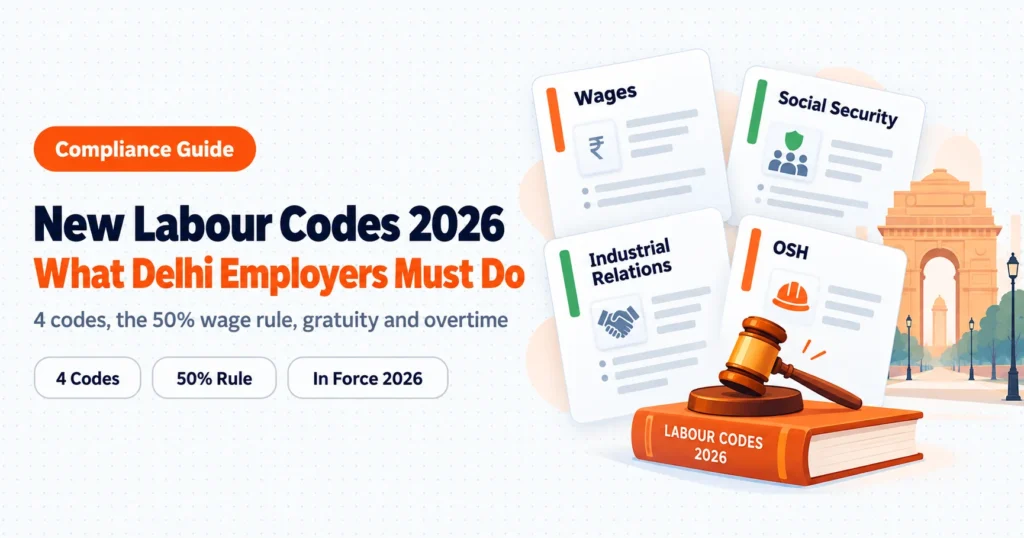
- Four codes, 29 laws: The Wages, Social Security, Industrial Relations, and OSH codes now replace a tangle of older central labour laws.
- The 50 percent rule: Basic pay plus DA must be at least 50 percent of total pay, which raises PF and gratuity and reshapes every salary structure.
- Gratuity sooner: Fixed-term employees now earn gratuity on a pro-rata basis, with no five-year wait.
- Appointment letters mandatory: Every employee must get a written appointment letter, no exceptions.
- Overtime at 2x: Overtime is now paid at twice the ordinary wage rate, with a cap on hours.
- Delhi still central-led: The codes apply across Delhi NCR on top of the Delhi Shops and Establishments Act, and Delhi still charges no professional tax.
What Are the New Labour Codes?
The new labour codes are four consolidated laws that merge 29 older central labour statutes into one modern framework. The aim is simpler compliance, wider worker coverage, and uniform definitions across the country. Instead of separate acts for wages, PF, ESI, disputes, and safety, employers now follow four codes.
Because they are central law, the codes apply across Delhi, Noida, and Gurugram alike. State governments notify the detailed rules, so some timelines vary by state, but the core obligations are national and already in effect in 2026.
The Four Labour Codes at a Glance
Here is what each code covers and the single biggest change it brings.
| Code | Replaces | Biggest change |
|---|---|---|
| Code on Wages, 2019 | Wages, bonus, equal pay laws | Basic plus DA must be at least 50 percent of pay |
| Code on Social Security, 2020 | PF, ESI, gratuity, maternity laws | Gig workers covered, gratuity for fixed-term staff |
| Industrial Relations Code, 2020 | Disputes, unions, standing orders | Fixed-term employment formalised with full benefits |
| OSH Code, 2020 | Factories, safety, migrant worker laws | Appointment letter mandatory, women in all shifts |
Code on Wages: The 50 Percent Rule
This is the change that hits every payroll. The code sets one universal definition of wages and requires that basic pay plus dearness allowance be at least 50 percent of total remuneration. So you can no longer keep basic artificially low and load the rest into allowances.
The code also sets a national floor wage, mandates timely payment of wages, and requires equal pay regardless of gender. For the mechanics of a compliant split, see the guide to salary structure in India, and always check pay against the notified minimum wages in Delhi.
Code on Social Security: PF, ESI and Gratuity
This code brings PF, ESI, gratuity, and maternity benefit under one roof and widens who is covered. Two shifts matter most for employers. First, gig and platform workers now get a social security framework. Second, the EPF wage ceiling has risen to Rs 25,000, which changes PF calculations for many employees.
The headline change is gratuity. Fixed-term employees now earn gratuity on a pro-rata basis with no five-year minimum service, so a one-year contract worker is still entitled to a gratuity payout. That reshapes how you budget for contract staff and handle their full and final settlement.
Industrial Relations Code: Fixed-Term Employment
The Industrial Relations Code formally recognises fixed-term employment. A fixed-term employee must now receive the same wages, hours, and benefits as a permanent employee doing the same work, including gratuity. This gives you flexible hiring without a second-class workforce.
The code also raises the threshold for prior government permission on layoffs, retrenchment, and closure to 300 workers, and requires standing orders for establishments at that size. Smaller Delhi NCR businesses gain more operational flexibility, while larger ones must formalise their rules.
OSH Code: Appointment Letters, Shifts and Overtime
The Occupational Safety, Health and Working Conditions Code modernises the workplace basics. The most practical change is simple: every employee must receive a written appointment letter. If you still hire on a verbal understanding, that stops now.
The code also lets women work in all shifts, including nights, with their consent and proper safeguards. It mandates a free annual health check for eligible workers, caps overtime hours, and requires overtime to be paid at twice the ordinary wage rate. A single registration and licence replaces multiple older ones.
What Changes for Your Salary Structure
The 50 percent rule has a knock-on effect you must plan for. When basic pay rises to half of CTC, both employee and employer PF go up, and gratuity accrues faster. Take-home pay dips slightly, while retirement savings grow.
So you cannot treat this as a paperwork exercise. Every offer and every existing salary needs a review to stay compliant, and the payroll components must be re-balanced around the new floor. Doing this by hand across a mixed Delhi, Haryana, and UP workforce is where errors creep in.
What Delhi Employers Must Do Now
Turn the codes into a short action list and work through it before the next payroll run.
| Action | Why it matters |
|---|---|
| Rebalance salaries so basic plus DA is 50 percent | Core Code on Wages requirement; affects PF and gratuity |
| Issue written appointment letters to all staff | Now mandatory under the OSH Code |
| Update PF for the Rs 25,000 wage ceiling | Changes contribution amounts for many employees |
| Give fixed-term staff full benefits and gratuity | Required by the Industrial Relations and Social Security codes |
| Set overtime at twice the wage rate | OSH Code overtime rule |
| Enable women’s night shifts with safeguards | Permitted with consent and safety measures |
How Payroll Software Helps You Comply
The codes add rules that are easy to state but hard to apply by hand, especially across multiple states. Payroll software applies the 50 percent split, the new PF ceiling, and the 2x overtime rate automatically, and it generates compliant appointment letters and payslips in one place.
That matters most for Delhi NCR employers, where Delhi, Haryana, and UP rules differ per employee location. A capable payroll software encodes each rule once and applies it correctly every month, so a legal change does not become a payroll mistake.
Final Word
The new labour codes are the most significant labour reform in a generation, and in 2026 they are no longer a proposal but the law you run on. The 50 percent wage rule, gratuity for fixed-term staff, mandatory appointment letters, and 2x overtime are the changes that will touch your payroll first.
For Delhi NCR businesses, the codes sit on top of the Delhi Shops and Establishments Act, and Delhi still levies no professional tax. Treat the codes as a structured project: review every salary, formalise every contract, and back it with software that keeps the rules current. Do that, and compliance becomes routine rather than a scramble.
Frequently Asked Questions
What are the four new labour codes?
They are the Code on Wages 2019, the Code on Social Security 2020, the Industrial Relations Code 2020, and the Occupational Safety, Health and Working Conditions Code 2020. Together they replace 29 older central labour laws.
Are the labour codes in force in 2026?
Yes. The codes are now in effect, replacing the earlier laws. States notify the detailed rules, so some procedural timelines vary, but the core obligations apply across India, including Delhi NCR.
What is the 50 percent rule in the new labour codes?
Basic pay plus dearness allowance must be at least 50 percent of an employee’s total remuneration. This raises PF and gratuity, lowers take-home slightly, and requires most employers to restructure salaries.
Do fixed-term employees get gratuity under the new codes?
Yes. Fixed-term employees now earn gratuity on a pro-rata basis with no five-year minimum service. A worker on a one-year contract is still entitled to a gratuity payout at the end of the term.
Is an appointment letter mandatory now?
Yes. Under the OSH Code, every employer must give each employee a written appointment letter. Verbal-only hiring is no longer compliant.
How much is overtime under the new labour codes?
Overtime must be paid at twice the ordinary wage rate, and total overtime hours are capped. This is a uniform rule under the OSH Code.
Do the labour codes change PF contributions?
Yes, in two ways. The 50 percent basic rule increases the wages on which PF is calculated, and the EPF wage ceiling has risen to Rs 25,000, which raises contributions for many employees.
Do the new codes apply to Delhi employers?
Yes. The codes are central law and apply across Delhi NCR on top of the Delhi Shops and Establishments Act. Delhi continues to levy no professional tax, while Haryana and UP rules still apply to your Gurugram and Noida staff.
