
Buddy punching, Excel registers, and self-reported attendance are the biggest reasons Indian payroll runs late every month. A biometric attendance system ends this by tying every check-in to a unique physical or behavioural identifier, then syncing the data straight to payroll. This guide explains every type of biometric attendance, the actual cost in India, the top device brands, integration with cloud HRMS, DPDP Act compliance, and the questions every Indian business should ask before buying.
- What it is: A biometric attendance system uses unique physical traits (fingerprint, face, iris, palm vein) or behavioural data to authenticate employee attendance, replacing manual cards and registers.
- Top types in India: Fingerprint scanners are the most common. Facial recognition is fastest growing. Iris and palm vein are used in high-security environments.
- Cost range: Devices start from Rs 4,000 for basic fingerprint readers and go up to Rs 60,000+ for facial recognition with multi-zone sync. Cloud software adds Rs 30 to Rs 100 per employee per month.
- Top device brands: eSSL, Matrix, Mantra, ZKTeco, and RealTime cover 80 percent of the Indian market.
- Mobile alternative: Selfie + GPS attendance via mobile app replaces hardware for distributed teams. No upfront device cost, native compliance with DPDP rules.
- DPDP Act 2023: Biometric data is sensitive personal data. Employers must obtain explicit consent, store data in India, and limit access via role-based controls.
What Is a Biometric Attendance System?
A biometric attendance system is an electronic method of recording employee check-in and check-out using unique biological identifiers. Instead of swiping an ID card or signing a register, employees authenticate themselves with a fingerprint, facial scan, iris pattern, palm vein, or voice. The system captures the time and location, validates the identity against a stored template, and pushes the data to attendance software that flows into payroll.
Indian businesses started adopting biometric attendance around 2008, initially in factories and BPOs, then across offices, hospitals, and educational institutions. By 2026, biometric attendance covers more than 70 percent of organised sector workforces in India, driven by buddy punching prevention, accurate overtime calculation, and compliance with the Factories Act and the Shops & Establishments Acts.
Types of Biometric Attendance Systems
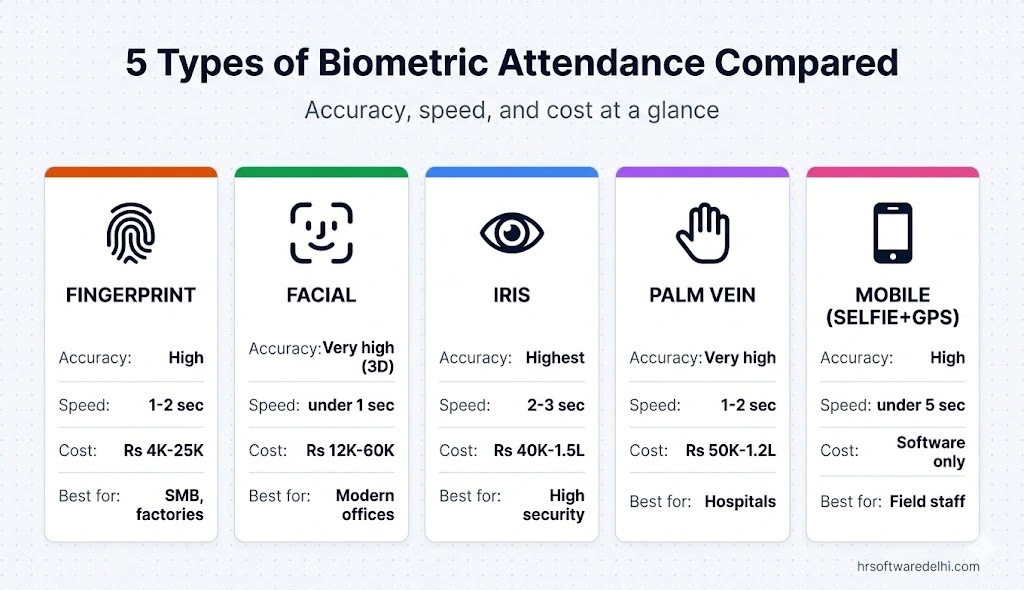
Indian businesses commonly use five types of biometric authentication. Each has cost, accuracy, and use-case trade-offs.
1. Fingerprint Recognition
The most widely used type in India. Employees place a finger on a scanner. The system captures minutiae points (ridge endings and bifurcations) and matches against a stored template. Accurate, affordable, and fast.
Best for: Offices, factories, retail stores, schools, small to medium businesses.
Limitations: Wet, dirty, or worn fingerprints reduce accuracy. Manual labour environments often see false rejections.
Device price range: Rs 4,000 to Rs 25,000 per unit.
2. Facial Recognition
Fastest-growing biometric type in India post-COVID. The system captures a 3D facial map (or 2D photo on cheaper devices) and matches it against the stored template. Modern AI-driven facial recognition works with masks, glasses, and varied lighting.
Best for: Modern offices, hospitals, clean rooms, any environment where touch-free is preferred.
Limitations: 2D-only systems are vulnerable to photo spoofing. 3D systems cost more. Privacy concerns require explicit consent under the DPDP Act.
Device price range: Rs 12,000 to Rs 60,000 per unit.
3. Iris Recognition
Highly accurate. The system captures the iris pattern using infrared cameras and matches it against a stored template. The iris has 240+ unique identifiers compared to 40+ for fingerprints.
Best for: High-security facilities, defence, banking back-offices, government installations.
Limitations: Expensive devices. Requires the employee to look directly into the scanner. Slower throughput compared to fingerprint or face.
Device price range: Rs 40,000 to Rs 1,50,000+ per unit.
4. Palm Vein Recognition
The system uses near-infrared light to scan the unique vein pattern under the skin of the palm. Touchless, hygienic, and almost impossible to spoof.
Best for: Hospitals, sterile environments, sensitive R&D facilities.
Limitations: Niche adoption in India. Higher cost than fingerprint or face. Limited Indian device brands.
Device price range: Rs 50,000 to Rs 1,20,000 per unit.
5. Mobile Biometric (Selfie + GPS)
An alternative to physical devices. Employees check in via the company’s mobile app using a selfie photo and GPS location. The system verifies the face against a stored profile and confirms the employee is within the geo-fence radius of the office or work site.
Best for: Field staff, sales teams, remote workers, distributed offices, multi-location businesses.
Limitations: Depends on smartphone availability. Battery and network reliability matter.
Cost: Zero hardware cost. Bundled with HRMS subscription, typically Rs 50 to Rs 100 per employee per month.
| Type | Accuracy | Speed | Cost | Best Fit |
|---|---|---|---|---|
| Fingerprint | High | Fast (1-2 sec) | Low to medium | SMB offices, factories, retail |
| Facial Recognition | Very high (3D) | Very fast (under 1 sec) | Medium to high | Modern offices, hospitals |
| Iris | Highest | Medium (2-3 sec) | High | High-security facilities |
| Palm Vein | Very high | Fast (1-2 sec) | High | Sterile environments |
| Mobile (Selfie + GPS) | High (with liveness check) | Fast (under 5 sec total) | Software only, no hardware | Field staff, distributed teams |
How a Biometric Attendance System Works
The end-to-end flow is the same regardless of which biometric type you use. Five steps move an employee’s identity from the scanner to the payslip.
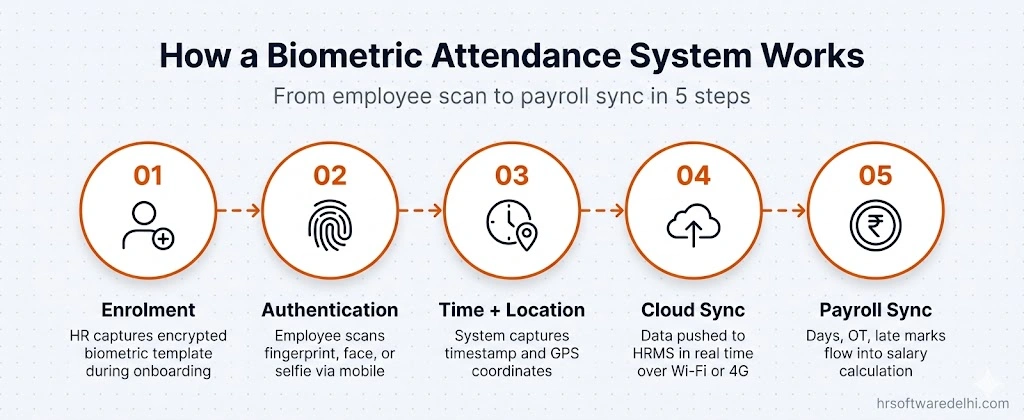
Step 1: Enrolment
When a new employee joins, HR captures their biometric template during onboarding. For fingerprint systems, three to four scans of the same finger are taken to build a robust template. For facial recognition, multiple angles of the face are captured. The template is encrypted and stored either on the device or in the cloud HRMS database. The original biometric image is never stored, only the mathematical template.
Step 2: Daily Authentication
The employee places their finger, looks at the camera, or takes a selfie via the mobile app. The system captures the live biometric data, generates a template, and compares it against the stored template using a matching algorithm. If similarity exceeds the configured threshold (typically 95-99 percent), the system marks the punch as valid.
Step 3: Time and Location Capture
Along with the biometric verification, the system records the timestamp and location. Hardware devices stamp the local device time. Mobile apps capture device time, server time, and GPS coordinates. The data is bundled into an attendance record.
Step 4: Sync to Cloud HRMS
Modern devices push attendance data to the cloud HRMS in real time over Wi-Fi or 4G. Older devices use push or pull mechanisms over a local network. The HRMS stores the punch data, applies shift rules, late marks, overtime logic, and produces the daily attendance summary.
Step 5: Payroll Sync
At month-end, the attendance software pushes consolidated data to the payroll module. Present days, half-days, late marks, overtime, and Loss-of-Pay days flow automatically into the salary calculation. There is zero re-entry, which is the single biggest reason cloud-connected biometric systems pay back their cost in the first 6 months. For a deeper view, see our walkthrough on how to process payroll.
Cost of Biometric Attendance System in India
The total cost has three components. Most buyers underestimate two of them.
1. Device Cost (One-Time)
| Device Type | Price Range (per unit) | Capacity |
|---|---|---|
| Basic fingerprint reader | Rs 4,000 to Rs 8,000 | 500 to 1,000 employees |
| Mid-range fingerprint with backup battery | Rs 10,000 to Rs 18,000 | 2,000 employees |
| Premium fingerprint with cloud sync | Rs 20,000 to Rs 30,000 | 5,000+ employees |
| 2D facial recognition | Rs 12,000 to Rs 25,000 | 1,000 employees |
| 3D facial recognition with AI | Rs 35,000 to Rs 60,000 | 5,000 employees |
| Iris scanner | Rs 40,000 to Rs 1,50,000 | 500 to 2,000 employees |
| Palm vein scanner | Rs 50,000 to Rs 1,20,000 | 500 to 1,000 employees |
2. Software Cost (Recurring)
The biometric device captures the data, but the cloud HRMS turns it into payroll-ready attendance. Software pricing in India typically falls in the Rs 30 to Rs 100 per employee per month range, depending on features and team size. Standalone attendance software costs less. HRMS bundles (attendance + payroll + leave + ESS) cost more but deliver more value.
3. Installation, Networking, and Maintenance
Installation runs Rs 2,000 to Rs 5,000 per device for cabling, power, and network configuration. Annual maintenance contracts (AMC) are typically 12 to 18 percent of device cost. Cloud sync requires reliable Wi-Fi or LAN at every check-in location.
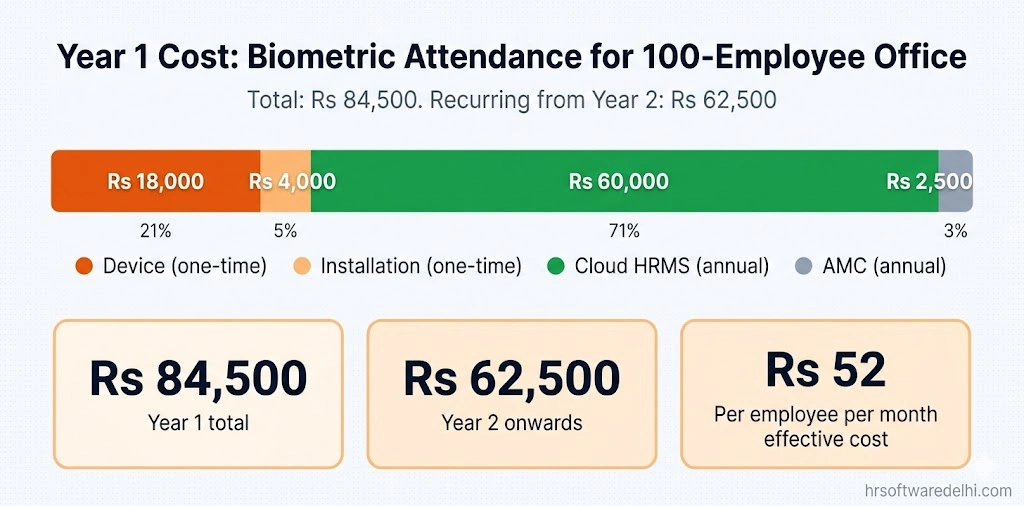
Total Cost Example: 100-Employee Office
A typical 100-employee Delhi NCR office with one entry point and one biometric device:
- 1 mid-range fingerprint device with cloud sync: Rs 18,000 (one-time)
- Installation and networking: Rs 4,000 (one-time)
- HRMS attendance software: Rs 50 per employee per month = Rs 5,000/month or Rs 60,000/year
- AMC: Rs 2,500/year
- Year 1 total: Rs 84,500
- Year 2 onwards: Rs 62,500/year
This compares favourably against the cost of manual attendance: HR time spent on Excel reconciliation, payroll errors, and disputed overtime add up to far more in lost productivity.
Top Biometric Device Brands in India
Five brands cover roughly 80 percent of the Indian biometric attendance market. Each has strengths in different segments.
eSSL Security
The largest biometric brand in India by installed base. Wide range of devices from entry-level fingerprint readers to high-end facial recognition systems. Strong distribution network across Tier 2 and Tier 3 cities. Devices integrate with most Indian HRMS platforms via API.
Matrix Comsec
Premium Indian brand based out of Vadodara. Strong in mid-market and enterprise. Reliable hardware with multi-zone capacity, RFID + biometric combination devices, and access control integration. Well-supported in Delhi NCR.
Mantra Softech
UIDAI-certified Aadhaar biometric devices. Strong fingerprint and iris scanner range. Often used by government and BFSI customers due to UIDAI certification. Indian-made hardware with local support.
ZKTeco
Global Chinese brand with strong India presence. Wide range of fingerprint, face, and palm devices at competitive prices. Good for SMBs looking for affordable cloud-connected devices.
RealTime Biometrics
Indian brand focused on facial recognition and fingerprint. Strong in retail, schools, and small offices. Affordable cloud HRMS bundle for end-to-end attendance to payroll.
Cloud Integration: Why It Changes Everything
A biometric device alone is just a clock. The value comes when it syncs to a cloud HRMS that handles shifts, leave, payroll, and compliance in one place. Three integration patterns are common in India.
Real-Time Push (Recommended)
The device pushes every punch to the cloud HRMS within seconds. HR sees live attendance from any office or branch. Late marks alert managers immediately. This is how modern systems work and is the standard for new deployments.
Scheduled Pull
Older devices store punches locally and the HRMS pulls data every few hours via a local agent or scheduled job. Works for offline-friendly environments but slower for HR analytics.
Manual CSV Export
The most basic and most error-prone integration. Someone exports a CSV from the biometric device weekly and imports into the payroll system. Avoid if possible. The tools we cover in our best attendance management software in India guide all support real-time push or scheduled pull.
DPDP Act 2023 and Biometric Data Compliance
Biometric data is classified as Sensitive Personal Data under the Digital Personal Data Protection Act 2023. Employers using biometric attendance must follow specific compliance requirements.
- Explicit consent: Employees must explicitly consent in writing to biometric data collection. The consent form must specify the purpose, retention period, and data sharing scope.
- Purpose limitation: Biometric data collected for attendance cannot be used for other purposes (such as marketing or law enforcement) without separate consent.
- Data localisation: Sensitive personal data must be stored on servers physically located in India. Most reputable Indian HRMS vendors comply with this by default.
- Storage minimisation: Store only the encrypted template, not the original biometric image. Templates should be cryptographically hashed.
- Access controls: Role-based access ensures only authorised HR personnel can view biometric data. Maintain access logs.
- Right to erasure: When an employee leaves, biometric data must be deleted within a defined retention period (typically 90 days post-exit).
- Breach notification: Any biometric data breach must be reported to the Data Protection Board within 72 hours.
Penalties under the DPDP Act can reach Rs 250 crore per breach. Compliance is not optional. Verify your HRMS vendor’s data localisation, encryption, and retention practices during evaluation.
Common Biometric Attendance Mistakes to Avoid
| Mistake | Better Approach |
|---|---|
| Buying biometric devices without checking HRMS API compatibility | Confirm the device brand integrates with your existing HRMS via API or push sync. Avoid CSV-only devices. |
| Storing biometric templates on the local device only | Sync to encrypted cloud storage to prevent data loss if the device fails. Maintain audit logs. |
| Skipping employee consent forms for biometric collection | Issue DPDP-compliant consent forms during onboarding. Refresh consent every 2 years or on policy change. |
| Choosing the cheapest device without checking employee capacity | Devices have firmware-level limits on stored templates. Verify capacity exceeds your peak headcount. |
| Ignoring backup attendance methods for device failures | Configure mobile app or RFID card as fallback. A single point of failure in attendance breaks payroll. |
| Buying biometric only for offices, ignoring field staff | Combine hardware biometric for office staff with mobile selfie + GPS for field teams. One HRMS, two collection methods. |
| Forgetting to update biometric templates as employees age | Schedule template refresh every 2 to 3 years to maintain accuracy. Faces and fingerprints change subtly over time. |
For a fuller compliance picture, our guide on labour laws in Delhi covers attendance record-keeping requirements under the Shops Act and Factories Act in addition to DPDP rules.
How to Choose the Right Biometric Attendance System
Five questions decide the right fit. Skip any of them and you will be replacing the system within 18 months.
- What is your work environment? Manufacturing units need rugged fingerprint devices that handle dust and grease. Modern offices benefit from facial recognition. Field staff need mobile-only solutions.
- How many entry points? One office with one entry needs one device. A multi-floor building or multi-location setup needs cloud-synced devices that aggregate data centrally.
- Will you have field staff or remote workers? Hardware-only systems leave field teams excluded. Combine hardware biometric for office staff with mobile selfie + GPS for distributed teams.
- How does it integrate with payroll? Real-time push to a cloud HRMS that runs payroll is ideal. CSV export should be a last resort. Reliable integration eliminates 80 percent of attendance disputes.
- Is the vendor DPDP compliant? Verify Indian data localisation, encrypted storage, role-based access, and a clear retention policy. Get this in writing before signing.
Final Word
A biometric attendance system is not a hardware purchase. It is the foundation of every accurate payroll run, every overtime calculation, every dispute-free month-end. Pick the wrong device and you will find yourself rebuilding attendance data in Excel forever. Pick the right combination of biometric and cloud HRMS and your HR team gets that time back.
If you are evaluating biometric attendance for an Indian business, our attendance management system integrates with all major biometric brands (eSSL, Matrix, Mantra, ZKTeco, RealTime), supports mobile selfie + GPS for field teams, and pushes attendance straight to payroll. DPDP compliance is built in. Book a 30-minute demo with our Delhi NCR team and see your real attendance flow on day one.
Frequently Asked Questions
How much does a biometric attendance system cost in India?
A complete biometric attendance system for a 100-employee office costs around Rs 84,500 in Year 1 (one mid-range device + installation + cloud HRMS) and roughly Rs 62,500 per year ongoing. Devices range from Rs 4,000 (basic fingerprint) to Rs 1,50,000 (iris scanner). Cloud HRMS adds Rs 30 to Rs 100 per employee per month depending on features.
Which type of biometric attendance is best for offices?
Fingerprint recognition is the most common for SMB offices due to low cost and reliable accuracy. Modern offices increasingly prefer facial recognition because it is touchless and faster. For high-security environments, iris or palm vein systems offer the highest accuracy. The right choice depends on your environment, hygiene requirements, and budget.
Are biometric attendance systems legal under Indian law?
Yes. Biometric attendance is legal in India for employer use, but it falls under the Digital Personal Data Protection Act 2023. Employers must obtain explicit written consent, store data on India-based servers, encrypt biometric templates, limit access via role-based controls, and delete data within 90 days of employee exit. Penalties for non-compliance can reach Rs 250 crore per breach.
Can biometric attendance work with mobile phones?
Yes. Mobile biometric uses selfie photo verification combined with GPS location capture. The mobile app verifies the live face against a stored profile and confirms the employee is within the geo-fence radius of the office or work site. This works for field staff, sales teams, and remote workers without any hardware investment.
What happens if a biometric device fails?
A well-configured system has fallback methods. Most modern HRMS platforms allow employees to use a mobile app, RFID card, or web punch as backup if the biometric device is offline. Local devices also store punches in memory and sync once the network is restored. Always configure at least one backup method to avoid attendance gaps.
Which biometric brands are best for Indian businesses?
The top five biometric brands in India are eSSL (largest installed base, wide product range), Matrix Comsec (premium Indian brand), Mantra Softech (UIDAI certified, strong in BFSI and government), ZKTeco (affordable global brand), and RealTime (popular in retail and schools). Choice depends on team size, budget, and HRMS compatibility.
Does biometric attendance integrate with payroll software?
Yes, modern biometric devices push attendance data to cloud HRMS in real time via API. The HRMS calculates working days, overtime, late marks, and Loss-of-Pay days, then syncs to payroll automatically at month-end. This eliminates manual data entry, reduces payroll errors, and shortens the salary processing cycle from days to hours.
Is facial recognition more accurate than fingerprint?
3D facial recognition with AI liveness detection is generally more accurate than fingerprint, especially in environments where employees have wet, dirty, or worn fingerprints (manufacturing, healthcare, food service). 2D facial recognition is similar in accuracy to fingerprint but cheaper. Fingerprint remains the most cost-effective choice for SMB offices with clean working conditions.
