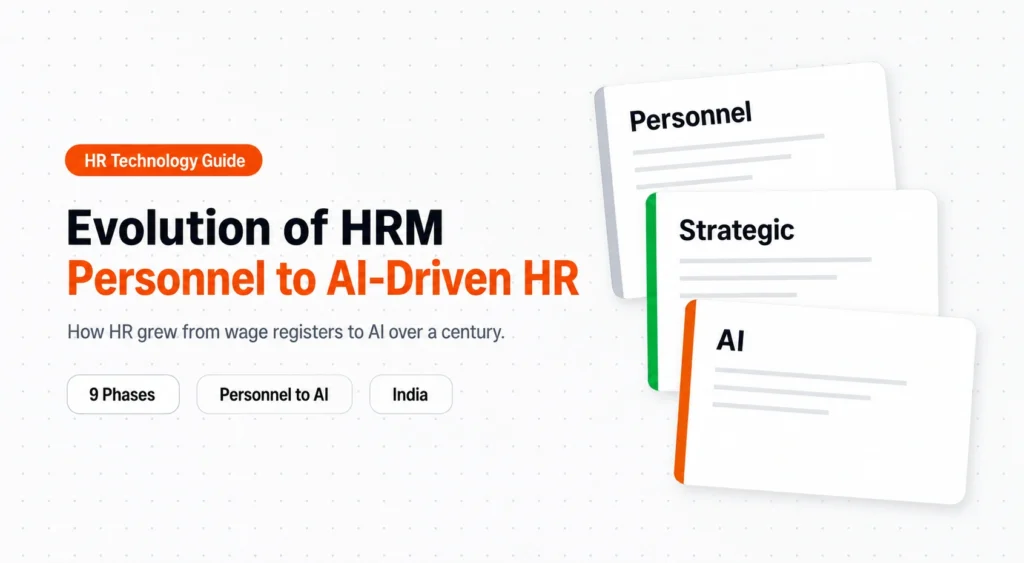
A century ago, managing people meant a clerk keeping wage registers and a factory foreman enforcing discipline. Today the same function runs on data, cloud software, and AI, and sits in the boardroom. The evolution of HRM is the story of how human resource management grew from basic record-keeping into a strategic driver of business results. This guide walks through the key phases, how HRM developed in India, and where it is heading next.
- From records to strategy: HRM moved from clerical personnel work to a strategic, data-led business function.
- Nine broad phases: From the industrial era and scientific management to today’s AI-driven, agile HR.
- Human relations shift: The Hawthorne studies proved that morale and relationships, not just efficiency, drive output.
- Technology turning point: HRIS, cloud HR, and self-service moved HR from paperwork to automation.
- India’s journey: HRM in India grew from labour welfare and personnel management to modern digital HR after liberalisation.
- The future: AI, people analytics, and employee experience now define the next stage of HRM.
What Is the Evolution of HRM?
The evolution of HRM describes how the management of people at work has changed over more than a century. It moved from controlling labour and keeping records to developing people, aligning them with strategy, and now using technology and data to shape the entire employee experience.
Each phase was driven by a mix of economic change, new ideas about people, and better tools. Understanding the journey explains why modern HR looks the way it does and where it is going next.
The Key Phases of HRM Evolution
The story is usually told in broad, overlapping phases. The dates are approximate, since practice shifted gradually rather than overnight.
1. Industrial Revolution and Early Labour (before 1900)
The factory system created large workforces for the first time. The focus was on output and discipline, with little concern for welfare. Early labour welfare officers appeared to handle basic working conditions, the first seed of a people function.
2. Scientific Management (1900 to 1930)
Frederick Taylor’s scientific management treated work as a set of tasks to optimise. The emphasis was on efficiency, standard methods, and performance-linked wages. People were seen mainly as units of production, not individuals.
3. Human Relations Movement (1930 to 1950)
The Hawthorne studies led by Elton Mayo showed that attention, morale, and group dynamics affected productivity more than physical conditions alone. This shifted thinking toward the social and psychological side of work.
4. Personnel Management (1950 to 1970)
Personnel departments formalised hiring, payroll, records, and industrial relations. The role was largely administrative and compliance driven, keeping the machinery of employment running rather than shaping strategy.
5. Human Resource Development (1970 to 1990)
The term human resource management took hold, framing people as assets to be developed, not just costs to control. Training, performance management, and leadership development became central, and HR gained a more strategic voice.
6. Strategic HRM (1990 to 2000)
HR aligned directly with business strategy. Workforce planning, succession, and employer branding mattered, and the first Human Resource Information Systems, or HRIS, began replacing paper. HR started to be measured on business outcomes.
7. Digital and Cloud HR (2000 to 2015)
Cloud based platforms, self-service portals, and automation transformed daily HR. Employees could apply for leave and view payslips themselves, and HR teams moved routine work off their desks. This is where tools like modern payroll software reshaped the function.
8. People Analytics and Employee Experience (2015 to 2020)
Data moved to the centre of HR. Teams measured engagement, predicted attrition, and used analytics to guide decisions. Diversity and inclusion and the overall employee experience became priorities, not afterthoughts.
9. AI-Driven and Agile HR (2020 to present)
Remote and hybrid work, AI, and a focus on wellbeing define the current phase. HR now uses AI for hiring, chatbots for queries, and analytics for planning, while managing gig and distributed teams with agility.
HRM Evolution at a Glance
The table below summarises how the focus of HR shifted across each phase.
| Phase | Period | Primary Focus |
|---|---|---|
| Industrial and early labour | Before 1900 | Output, discipline, basic welfare |
| Scientific management | 1900 to 1930 | Efficiency and performance pay |
| Human relations | 1930 to 1950 | Morale and group dynamics |
| Personnel management | 1950 to 1970 | Records, payroll, compliance |
| Human resource development | 1970 to 1990 | Training and people as assets |
| Strategic HRM | 1990 to 2000 | Business alignment and HRIS |
| Digital and cloud HR | 2000 to 2015 | Automation and self-service |
| People analytics and experience | 2015 to 2020 | Data, engagement, inclusion |
| AI-driven and agile HR | 2020 to present | AI, wellbeing, hybrid work |
Personnel Management vs Modern HRM
The clearest way to see the evolution is to compare the old and new mindsets. Personnel management was reactive and administrative, treating people as a cost to manage. Modern HRM is proactive and strategic, treating people as the source of competitive advantage.
Where personnel management focused on records, rules, and compliance, modern HRM focuses on development, engagement, and business results, powered by technology. If you are new to the tools behind this shift, this guide to what HR software is a useful starting point, and the difference between HRIS, HRMS, and HCM shows how the platforms themselves evolved.
Evolution of HRM in India
HRM in India followed the global path with its own context. Early practice centred on labour welfare and industrial relations, shaped by laws like the Factories Act 1948 and strong trade unions. Personnel management dominated through the decades of a controlled economy.
The 1991 economic liberalisation was the turning point. As multinationals arrived and competition grew, Indian companies adopted strategic HRM, then digital HR. Today, Indian HR teams run cloud HRMS, manage multi-state compliance, and use analytics, while the new labour codes continue to reshape the rules of work.
The Future of HRM
The next stage is being written now. AI will handle more of hiring, query resolution, and analytics, freeing HR for judgement-heavy work. Skills, rather than fixed roles, will guide workforce planning, and employee experience and wellbeing will stay central.
The constant across every phase is that better tools let HR spend less time on admin and more on people. When routine work runs on HR automation, the function keeps moving up the value chain, exactly as it has for the last hundred years.
Final Word
The evolution of HRM is a steady move from controlling labour to developing people, and from paperwork to data. Each phase kept the useful parts of the last and added a new layer, compliance, then development, then strategy, then technology, and now intelligence.
For any business today, the lesson is simple. HR is no longer a back office cost, it is a strategic function that grows with the right tools. Understanding where HRM came from makes it easier to choose where to invest next, starting with the software that carries the routine work.
Frequently Asked Questions
What is the evolution of HRM?
The evolution of HRM is the way people management has changed over more than a century, from controlling labour and keeping records to developing people and using data and technology. It moved through personnel management, human resource development, strategic HRM, and today’s AI-driven HR.
What are the main phases of HRM evolution?
The main phases are the industrial and early labour era, scientific management, the human relations movement, personnel management, human resource development, strategic HRM, digital and cloud HR, people analytics and experience, and today’s AI-driven, agile HR.
What is the difference between personnel management and HRM?
Personnel management was administrative and reactive, focused on records, payroll, and compliance, and treated people as a cost. Modern HRM is strategic and proactive, focused on development, engagement, and business results, and treats people as a source of competitive advantage.
How did technology change HRM?
Technology moved HR from paperwork to automation. HRIS, then cloud HRMS and self-service portals, let employees handle leave and payslips themselves, cut errors, and freed HR teams for strategic work. Data and AI now guide hiring, engagement, and workforce planning.
What is strategic HRM?
Strategic HRM aligns HR directly with business goals. Instead of only processing employees, HR plans the workforce, builds succession pipelines, shapes the employer brand, and is measured on business outcomes. It emerged strongly in the 1990s alongside early HR systems.
How has HRM evolved in India?
HRM in India began with labour welfare and industrial relations under laws like the Factories Act 1948. Personnel management dominated the controlled-economy decades, and the 1991 liberalisation drove the shift to strategic and then digital HR, now supported by cloud HRMS and the new labour codes.
What is the future of HRM?
The future of HRM is AI-driven, skills-based, and experience-led. AI will take over more hiring, analytics, and query resolution, workforce planning will focus on skills rather than fixed roles, and employee wellbeing and experience will remain central priorities.
Why is understanding HRM evolution important?
Understanding the evolution explains why modern HR works the way it does and helps businesses decide where to invest next. It shows that HR has steadily moved up the value chain, and that adopting the right tools is how a company keeps its HR function future ready.
